
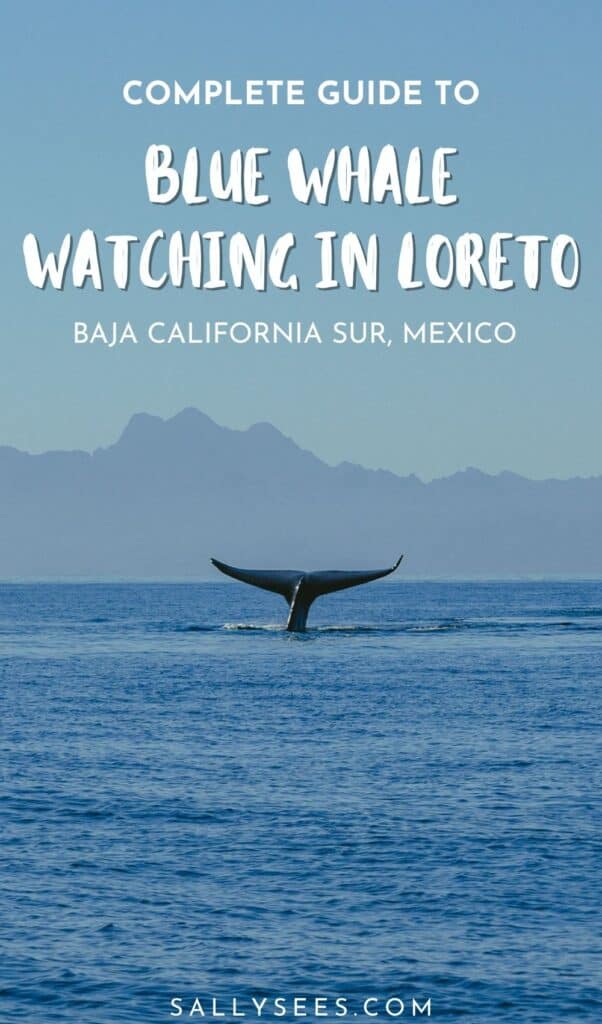
In this post, we’ll share everything you need to know about blue whale watching in Loreto, and how you can encounter the largest animal in the world!

This article may contain affiliate / compensated links, that may earn me a small commission, at no extra cost to you. For full information, please see our disclaimer here. While all efforts have been taken to ensure the information included in this post is correct and current, travel information such as opening hours, business operations and prices change frequently. If you find anything in this post that is incorrect or outdated please let me know in the comments so I can update it for other readers.
Blue whales in Loreto Mexico
There aren’t too many places where you can get up close with the largest animal in the world.
Loreto in Baja California Sur, Mexico is one of them.
Located in the northeast of the state, the small city of Loreto sits on the shores of the Gulf of California (aka the Sea of Cortez).
The Loreto Bay National Marine Park is a sheltered bay and protected area inside the Sea of Cortez. The bay is home to five uninhabited islands and an abundance of marine life.
The calm, sheltered waters provide the perfect haven for blue whales.
For a short period each year, the whales migrate to the waters of Loreto Bay, and visitors have the opportunity to lay eyes on the largest animal to ever roam the earth.
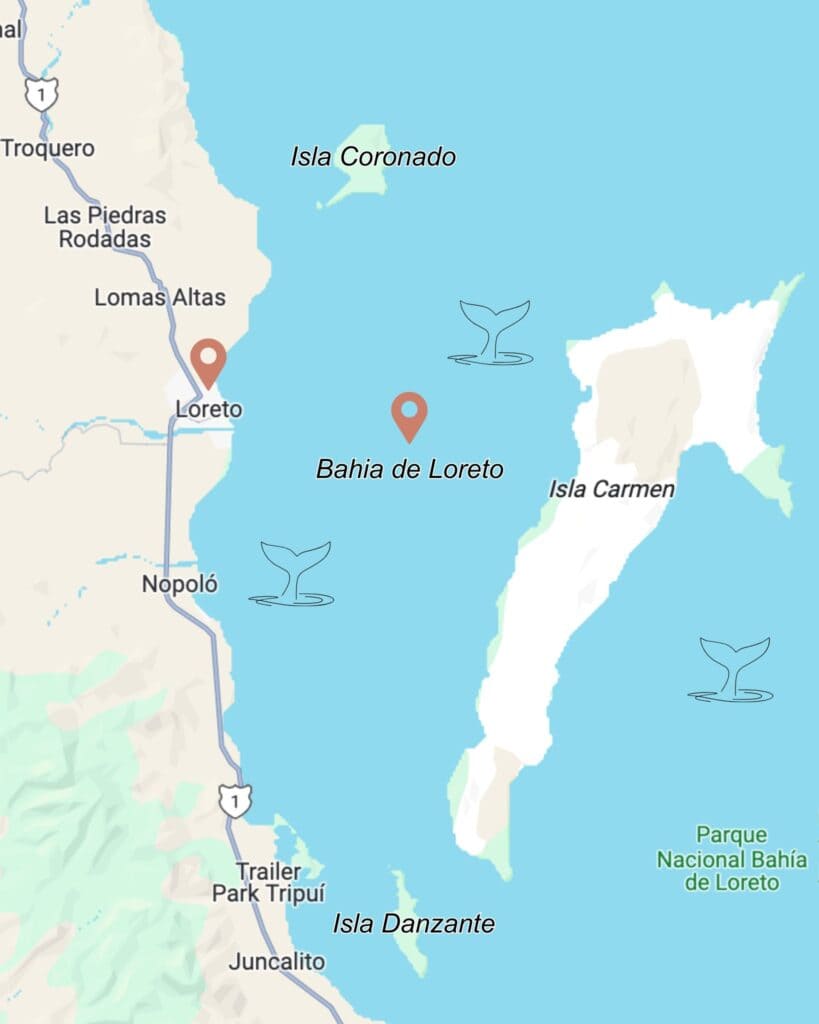
Loreto blue whales quick facts
- 📍 Where: In the Loreto Bay National Marine Park, with tours departing from either the Loreto Marina in town or from the Marina Puerto Escondido south of the city.
- 🗓️ When: February – March, can be mid-February depending on the year.
- 🛥️ How: A single-day whale watching boat tour that generally runs for 4 – 6 hours.
- 🐋 Tour Recommendation: For a shared tour, Loreto Sea and Land Tours, or for a private boat for just your group, Loreto Blue Whales.

About blue whales
🚌 HOW BIG ARE BLUE WHALES?
Blue whales are the biggest animals on the earth.
I know I said that already, but it is worth repeating because these ginormous creatures are HUGE!
An adult blue whale can grow up to 200 tons, but they usually weigh about 150 tons on average.
That is the equivalent of eight large school buses or 85 standard cars.
To put that into context, elephants are the largest terrestrial animals, and they weigh in at just 5 tons on average!
A blue whale’s tongue alone can weigh as much as an elephant. And the size of their heart is equivalent to a Volkswagon Beetle.
Blue whales grow to around 80 – 100 feet / 24 – 30 metres in length, longer than two large school buses. Mind-blowing.

🦐 WHAT DO BLUE WHALES EAT?
Blue whales most commonly eat krill, a small crustacean. A big whale can ingest up to 6 tons per day!
Blue whales are baleen whales, meaning they don’t have teeth, but rather a ‘baleen’.
The baleen is a filter system that allows the whales to intake large amounts of water, trap their food and then expel the water.
✈️ LOUDER THAN A JET PLANE?
They are considered the loudest animals on the planet, emitting up to 188 decibels. A jet plane only reaches around 140 decibels.
Their calls are used for communication and sonar navigation and can be heard up to 1,000 miles away.
🗓️ HOW LONG DO BLUE WHALES LIVE?
Blue whales are one of the longest-living animals in the world. On average, they live to around 90 years old.
The oldest living blue whale ever discovered was 110 years old!
🚨 CURRENT STATUS
Like many whale species, blue whales were hunted to near extinction in the 1900s.
These days they are a protected species, and their populations are slowly increasing.
However, they are still listed as endangered on the IUCN Red List.
It is estimated there are only 10,000 – 25,000 blue whales left in the wild.
Due to their sheer size, they don’t have a lot of predators, but there have been cases of blue whales being killed by sharks and orcas.
Their main threat is habitat and food loss, with climate change disturbing the population of their main food source, krill. Boat accidents with large vessels are another major issue.
The blue whales that visit Loreto are protected as part of the national park. Activities such as fishing and tours are highly regulated, and development has been limited around the bay.
🗺️ WHY ARE THE BLUE WHALES IN LORETO MEXICO?
Blue whales are one of the most elusive whales, and not much is known about their migration patterns.
There are five sub-species concentrated in different oceans around the world.
Those who come to Loreto each year are part of the eastern North Pacific population.
It’s thought that they spend the warm summer months feeding off the west coast of the USA and Alaska in the North Pacific.
Come winter, they migrate south to warmer waters in Mexico and Central America, with a lot of whales turning up in the Sea of Cortez in Loreto.
Many say they come to Loreto to mate and give birth, like the other species of whale in Baja.
But that is not confirmed, and a lot of marine biologists believe it is purely to feed in the nutrient-rich waters of the Sea of Cortez.
They lead a mostly solitary life but are occasionally spotted in pairs.
Mothers have been spotted with calves in the bay, giving credit to the theory they come to Loreto to give birth.


🐋 Interested in learning more about these fascinating creatures? I loved reading these sources and used them as references for the facts I shared here:
When to see blue whales in Loreto
The blue whales have the shortest migration period of all the whales that come to Baja California Sur.
The season for blue whale watching in Loreto runs from just February – March each year.
The exact timing changes every year. Sometimes the whales don’t arrive in Loreto until mid-February.
The blue whales are quite shy, and there is no guarantee you will spot any.
Staying in contact with experienced local tour operators in Loreto is the best way to plan your tour, as they are constantly monitoring the Loreto Bay National Marine Park and can advise when the first whales are spotted for the season.
We did our Loreto whale watching tour on the 6th of February, and we were very lucky to spot five whales!
However, we were in frequent contact with our tour company beforehand and were fully prepared to not be able to do the tour if they hadn’t sighted any whales by the time we wanted to go.

Blue whale tours Loreto
There are only two main local tour operators that run blue whale tours in Loreto.
- Group tours
- 7 – 19 passengers
- 5 – 5.5 hours (usually 8 am – 1:30 pm)
- Priced from 2,00 MXN + per person
- Lunch included
- National park entry fees not included (approx. 215 MXN per person)
- Private tours – you book the entire boat
- 2 – 4 passengers
- 8 hours (usually 6-7 am – 2-3 pm)
- Priced from 2,800 MXN + per person
- Lunch included
- National park entry fees included
We personally went with Loreto Sea and Land Tours and can vouch for them. We loved that there was a qualified marine biologist on board, who taught us lots about the whales and their behaviour.
Alternatively, if you are a bigger group or looking for something private, Loreto Blue Whales organises tours solely for your group, and you will have the entire boat to yourselves.

What to expect going blue whale watching
The tours usually depart first thing in the morning at 7 or 8 am.
Where you will board the boat depends on the exact area of the bay the whales decide to ‘settle’. This changes each year.
Most commonly, they are found in the south of the bay, around Isla del Carmen and Isla Danzante.
You will most likely meet in the morning at the marina in town on the Malecon.
However, if the whales are in the very south area of the bay, you may sometimes depart from the Marina Puerto Escondido about 20 minutes south of Loreto. This reduces your travel time on the boat and gives you more time on the water with the whales.
From there, you cruise for around 30 minutes to wherever the whales have recently been sighted. Then the wait begins!
The waters in the bay are (usually) calm, and in the morning light, it looks like silk.
During our visit, we were hanging around off the coast of Isla del Carmen, and before we even spotted any whales I was in absolute awe of the mountainous island against the blue waters. Just beautiful!


Remember that blue whales are wild animals, and there is no guarantee that you will see any.
On the flip side, the tour operators won’t offer the experience if they don’t believe the whales are there. So you have a pretty good chance of seeing them, but how long you need to wait depends on the whales!
On our visit, we got incredibly lucky and spotted five different whales throughout the four hours we spent in that area of the bay.
Due to their sheer size, blue whales aren’t acrobatic like humpback whales, and they aren’t interactive like the grey whales in Magdalena Bay.
What is so impressive about these guys is their enormity! Even just seeing a sliver of their back as they arch out of the water, you can gauge how huge these creatures are.


We were very impressed with our tour with Loreto Sea and Land Tours, and we had a marine biologist on board who shared a lot of valuable and interesting information about the whales, and the behaviours we were seeing.
We were blessed to see the whales performing a lot of different behaviours. We were able to see them feeding, eating, and pooping.
Trust me, that is way cooler than it sounds, their poos are huge and red from all the krill they eat!
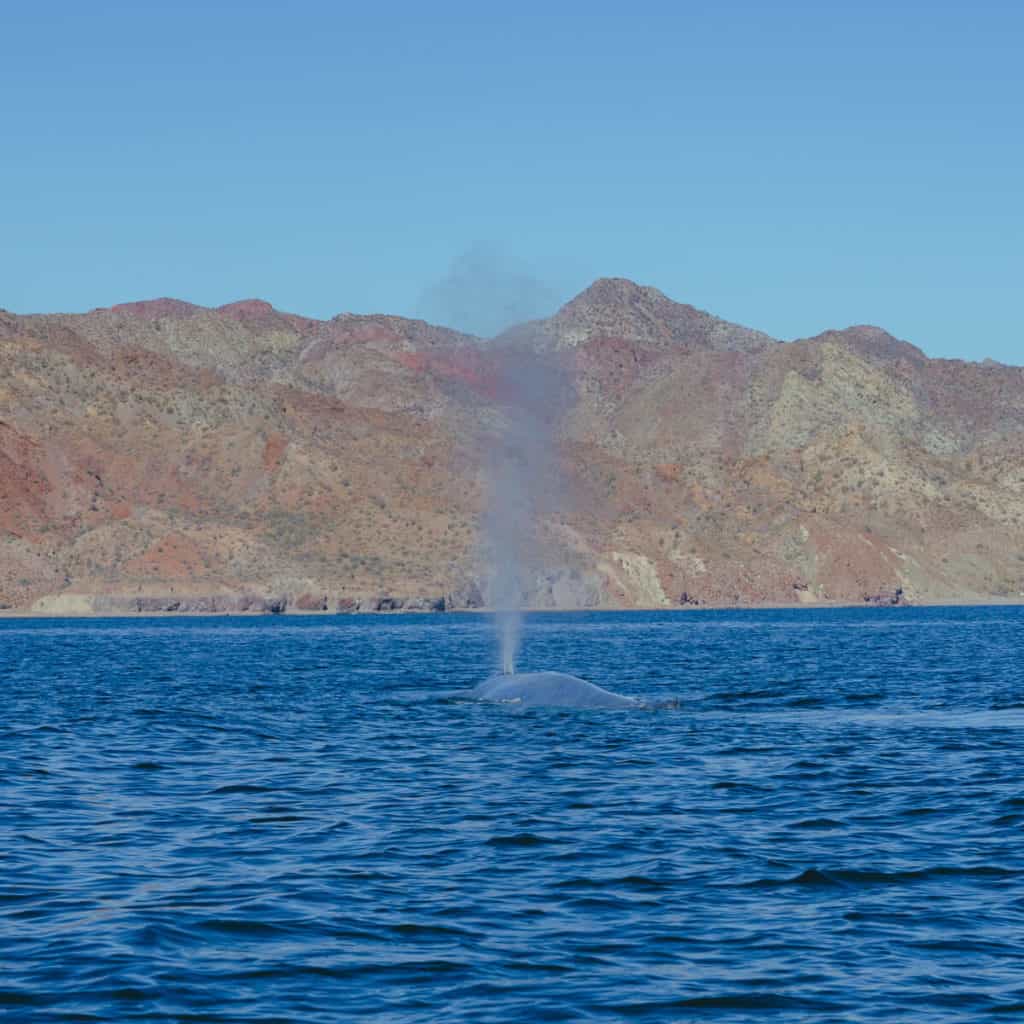
We saw the huge puffs of air and water flying out of their blowhole, which is usually the first sign you have that a whale is surfacing.
We watched them swimming along, arching their backs and dorsal fins out of the water.
We also learned a fun fact that not all blue whales exhibit ‘fluking’.
This behaviour, very common in other species like humpback and grey whales, is when the whale dives down deep, sticking their tail (fluke) out of the water as they go.
Blue whales don’t always do this, and most whales will dive down without revealing their large fluke above the surface.
As you can see from the photo below, we were lucky enough to see a blue whale fluke. It was very interesting to know that what we saw was a unique behaviour.


We had lunch served on board, which was burritos, fruit and an agua fresca to drink. All very yummy.
Usually, lunch will be served on a beach on one of the nearby islands. But the whales were still very active when we were ready to eat, so we stayed on the boat, and abandoned the food on many occasions to zoom over to where the latest whale had popped up.
In addition to blue whales, you’ve got a good chance of seeing a ton of other wildlife whilst you’re out on the water in Loreto Bay.
Humpback whales, fin whales and sei whales are also regulars in the bay. As well as dolphins, rays, sea lions and turtles.
We saw a humpback whale, dolphins and a turtle on our tour as we were coming and going from the area with the blue whales.
The scenery of the islands is simply spectacular too. The entire experience of being out on the water was incredible, even when we were waiting for the whales to surface.
Is blue whale watching ethical?
We were very impressed with the ethics of the blue whale watching experience in Loreto.
Boats and guides must be trained and registered with the national park agency, and follow strict rules regarding approaching the whales.
There was just a handful of boats out on the bay, and (most) were following the rules.
Our captain never directly approached the whales head-on and always stopped a respectful distance away.
We even spotted CONANP, Mexico’s national park authority, out on the water, checking everyone was doing the right thing.
The whales are in complete control of the experience. If they are not interested, they dive deep and swim away.
The feeding behaviours that we saw indicate that the whales were comfortable and not bothered by our presence. They just continued on with their day, because we respected them from afar.


What to pack
Most things are provided by your tour company on board the boat, but a couple of things to remember for your tour:
- 🧥 Jacket – although sunny, winter in Loreto can be chilly. It’s windy out on the water, so bring a jacket and layers.
- 💧 Reusable water bottle – to fill up on board. Both companies are conscious of single-use plastic waste.
- 😎 Sunglasses – it’s bright on the water. Applying some sunscreen wouldn’t hurt either.
- 📸 Camera – fully charged with spare batteries to capture your amazing encounters!
❌ Drones are not allowed to be flown in the marine park. Don’t bother bringing it if you have one.
Final thoughts: Loreto whale watching
Being able to witness first-hand the largest creature to ever roam the planet is a pretty special experience.
I read an interesting statistic somewhere that less than 1% of the world’s population will ever be able to see these animals up close.
It’s an amazing opportunity to be one of those lucky few. I encourage you to take it up if you’re in Loreto!
Blue whales are elusive creatures, but going blue whale watching in Loreto at the right time of the year gives you a very good chance of spotting them.
We highly recommend planning your Baja California Sur trip around the abundance of whales in the area, the blue whale is just one!
Check out our post about whale watching in Baja California Sur to learn more about how you can also see grey whales, humpback whales and whale sharks.
And don’t forget our Loreto Travel Guide to help you plan some other activities in this charming little town.
🐋 Looking for more whale encounters? Baja is blessed with rich seas full of whales and other marine life. We have a dedicated guide to whale watching in Baja California Sur, and you can also read more about kissing grey whales in Magdalena Bay, humpback whale watching in Cabo and swimming with whale sharks in La Paz.
MORE LORETO POSTS
OUR BAJA CALIFORNIA SUR TRAVEL GUIDES





The Comments
Diana Gutiérrez López
-La ballena gris no es común en la Bahía de Loreto, en cambio es muy común observar ballena de aleta, la segunda más grande del mundo.
-No es correcto llamar el “mar de Cortez”, utilicen “Golfo de California” por respeto a la historia de los grupos indígenas que fueron invadidos y saqueados durante la colonización.
-Recordar a los visitantes que deben pagar y usar su brazalete personal de ingreso al Parque Nacional Bahía de Loreto.
-El método de observación de ballena azul dentro del Parque Nacional Bahía de Loreto, está basado en investigación científica y es el único lugar en el mundo en que es posible escuchar y ver a la ballena azul.
– Solo se puede hacer la observación de ballena azul por medio de un tour autorizado, no es posible ir en embarcaciones privadas.
Sally
Diana Gutiérrez LópezThankyou for your comment and additional information Diana, much appreciated. Sally
Justin Bos
This is great info. We are going to Loreto in 1st of Feb and would love to see the whales. What is the weather like?
Sally
Justin BosThanks for your comment Justin! February is winter in Loreto, but we experienced beautiful blue sunny days. The wind often picks up in winter, so expect to be chilly on or around the water. Heading inland or hiking you’re likely to be warm in the sun, but on our blue whale tour we were rugged up with jackets and beanies. But seeing the sunshine everyday was incredible! I hope you have a fantastic trip. Sally
Lisa Belkin
Greetings
My family of three, myself and two adult daughters will be staying in La Paz. What is the best way possible to join up with a group further north towards Loreto to see the Blue Whales? We do have a car. We already have plans for Magdalena Bay and the 17th to snorkel with the whale sharks. We had done this trip in 1999 where we flew up to the bay from Cabo. My daughter and I really want to see the Blue Whales. My whole life I’ve walked under the model in the hall of Ocean Life at the American Museum of Natural History where I used to work. My other daughter has seen them off of Cape Town and in New Zealand. She currently works in South Sudan for Fauna-Flora International managing Southern National Park which was decimated during South Sudans war for independence. I hoping that if you are not able to get us in can you recommend a way to get up close enough to board a ship. Much appreciated. Best regards
Lisa Belkin.
Sally
Lisa BelkinHi Lisa, how exciting! It sounds like you have some whale-filled adventures planned in Baja, and yes, blue whales absolutely need to be a part of that! Especially considering how much your family is involved with wildlife and nature. If you have a car, and you’re already going to Magdalena Bay, I would suggest driving on to Loreto from there. It’s actually closer to go to Loreto from Magdalena Bay (~2.5 hours), than it is to go back to La Paz (~3.5 hours). You could possibly return your rental car in Loreto, if not, the drive to La Paz would probably be a full day – but so worth it! I would recommend doing the whale sharks in La Paz, driving to Magdalena Bay for your grey whale experience, and then on to Loreto for the blue whales. All the best, Sally