
In this post, we will share everything you need to know about whale watching in Baja California Sur, Mexico. We’ll cover where, when and how to see a variety of whale species, like grey, blue and humpback whales, and whale sharks.

This article may contain affiliate / compensated links, that may earn me a small commission, at no extra cost to you. For full information, please see our disclaimer here. While all efforts have been taken to ensure the information included in this post is correct and current, travel information such as opening hours, business operations and prices change frequently. If you find anything in this post that is incorrect or outdated please let me know in the comments so I can update it for other readers.
Whale Watching in Baja California Sur
Sitting at the southern end of the Baja Peninsula, the Mexican state of Baja California Sur is one of the best places in the world to go whale watching.
With the Pacific Ocean to the west, and the Sea of Cortez (Gulf of California) to the east, Baja is seriously a whale lover’s heaven!
These two bodies of water converge at the southern point of the Baja Peninsula and collectively create the perfect environment for many species of whales to eat, mate and give birth to their young in the cold winter months.
The whales are what drew us to Baja California Sur in the first place.
These amazing creatures have always had a special place in my heart, and being able to witness so many different species in one place, in the space of just a few weeks was pure magic.
In this post, I’ll share everything you need to know about Baja California whale watching. From what kinds of whales you can see, where you can see them and what time of the year is best.
GRAB A COPY OF MY BAJA CALIFORNIA SUR TRAVEL GUIDE!
After falling absolutely in love with Baja, I decided to put together a Baja California Sur Travel Guide eBook to help anyone planning a trip to Baja California Sur.
This eBook is designed to be a go-to quick reference guide for the best places to visit around the state, allowing you to be confident you’re hitting all the highlights without needing to do hours of research.
This 153-page eBook covers 13 top destinations across the state, with recommendations for where to eat, stay and play, as well as regional information about climate, transport, and tour recommendations.
It’s filled with all our best tips and advice, and beautiful photos to excite and inspire you ahead of your trip to this incredible part of Mexico!
There is also the option to add a customised Google Map that has over 450 locations pinned by category, allowing you to easily visualise our recommendations across the state.
Find out more about the guide here.

Baja California Sur whale watching cheat sheet


What type of whales can you see in Baja California?
The waters around Baja host an abundance of different whale species of all shapes and sizes.
Although not all of these species have specific whale watching tours.
Some have more reliable migrations and locations than others, and come in larger numbers to warrant dedicated whale watching tours.
🐳 The main species you can expect to see, and can take specific Baja California whale watching tours for, are:
- Grey whales
- Blue whales
- Humpback whales
- Whale sharks (not technically a whale, but I’m including them!)
There are plenty of other, less common types of whale around Baja that you may be lucky to see.
Spotting one of these species is more like a chance encounter, as many of them are quite elusive and hard to track down, so there are no dedicated tours. If you’re out on the water in Baja, there is always the possibility to see whales!
🐋 The more commonly seen of these species are:
- Orcas (killer whales) – they live around Baja year-round and travel between the Pacific and Sea of Cortez, chasing sources of food. They can be seen around Los Cabos when humpback whales are birthing, near La Ventana and La Paz when the mobula rays congregate, and in the Pacific near Magdalena Bay for the annual sardine runs.
- Fin whales – the second largest animal in the world, and a very impressive species to see! They live year-round in the Sea of Cortez and are commonly spotted around Loreto during blue whale watching tours.
- Sperm whales – these whales are rare to see, but usually travel in large groups and are often seen resting on the surface of the water, after feeding at extremely low depths. They can be found in the Sea of Cortez and the Pacific.
When can you see whales in Baja?
🗓️ The optimal time to go whale watching in Baja California Sur is February – March
As you can see from the above chart, the optimal time to go whale watching in Baja California Sur is February – March.
The blue whale is the hardest to spot, with the shortest migration of all the species, so we would suggest working backwards from there.
By timing your visit for the blue whales, you will also be able to encounter all other species which are still present in the waters around Baja California Sur from February – March.
However, it is important to note that the whales are wild.
Although these species follow a relatively consistent migration pattern, it’s impossible to know exactly which date they will arrive in the region, and when they will leave.
Or if you will even see them at all!
Working with experienced local tour operators is the best way to stay up to date with the whales, and find out when they are first spotted for the season in their respective locations.
Many tour companies will offer a whale sighting guarantee, meaning you will either get your money back or get a second tour for free if you don’t spot any whales.
Look out for this when organising your whale watching in Baja California, because if a tour company is offering this guarantee, that means they are 99.9% certain the whales are around and the season has begun!
🌤️ Trying to coordinate whales and weather? Get an overview of the weather each season in Baja California Sur
Where is the best place to see whales in Baja California?
It depends on the type of whale you want to see!
I often read blog posts with a lot of incorrect information and misconceptions about Baja whale watching.
There is no one place in Baja where you can see all these species of whales.
As you can see in the map above, the whales are spread all over the state, from the Pacific to the Gulf of California. You can’t stay in one place and see every kind of whale.
Some of the most popular destinations for Baja whale watching tours are:
- 📍 Los Cabos – the most popular destination in Baja. This is the best place to go humpback whale watching. It’s possible to do day trips to swim with whale sharks in La Paz, and you can take overnight tours to Magdalena Bay to see the grey whales. You cannot see blue whales from Cabo.
- 📍 La Paz – the state’s capital is the only place you can go swimming with whale sharks. Its location means it is possible to do day trips to Cabo for humpback whale watching tours, as well as day trips to Magdalena Bay to see the grey whales. Blue whales do occasionally hang out in the waters off La Paz, but you can’t take dedicated tours here, and Loreto is too far for a day trip.
- 📍 Loreto – this is the home of the blue whale. Loreto is much farther north than other popular destinations in Baja Sur, so if you want to see the blue whales, you need to add some extra time to your trip or fly in/out of Loreto. It has an international airport. It’s possible to take day trips to Magdalena Bay to see the grey whales.
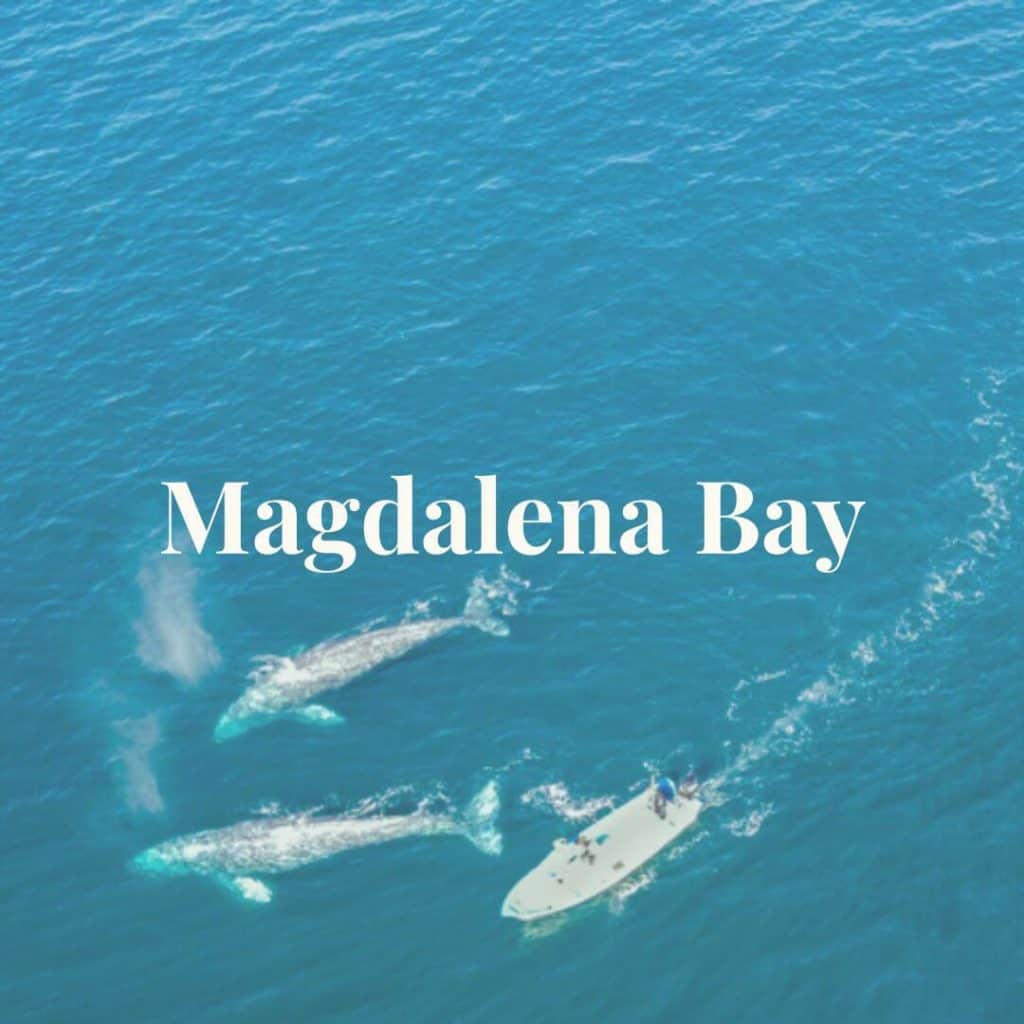
- 📍 Magdalena Bay – the most southern of the three lagoons grey whales migrate to. Magdalena Bay is the most suitable option for travellers visiting other popular parts of Baja Sur. It’s accessible from Loreto and La Paz for a day trip, and from Cabo as an overnight tour.
- 📍 Ojo de Liebre (Guerrero Negro) – this is the northernmost grey whale lagoon, near the city of Guerrero Negro. It is right on the state border between Baja Sur and Baja Norte and is most suitable for people travelling south from the US, or spending most of their time in the north of the peninsula.
- 📍 San Ignacio – the final of the grey whale lagoons, San Ignacio is essentially right in the middle of nowhere. It requires some effort to get to, but the rewards are worth it. This is considered the best lagoon to see grey whales (although there isn’t really any evidence to back this up).
How Baja whale watching works
The whale watching experience in Baja differs depending on which whales you are looking for, and in what location.
In the following sections, I’ll deep dive into what the experience is like for the main types of species (grey, blue, humpbacks and whale sharks), but as an overview, here’s what you can expect going whale watching in Baja California.
Whale watching is highly regulated by the Mexican Government, all over the country. You can only go whale watching on a formal tour, offered by a licensed operator.
There are strict regulations in place for who can offer whale watching tours, training for captains, and rules about approaching whales and how to ethically ‘watch’ whales.
That’s not to say this is always followed or enforced, but for the most part, whale watching in Baja is ethical and well-managed.
Most tours are taken on pangas. This is the Mexican term for a small, skiff-style boat with an outboard motor. Most can hold around 10 passengers, some have shade covers, and others are completely open.
If your captain is doing things right, you will all be on the lookout for any sign of a whale. A spout from their blowhole, a splash from a fin or tail, or an arch of the back peeking over the surface of the water.
Once you’ve got eyes on a whale, your captain will approach. As you get closer, they should slow right down and usually cut the motor or turn it to idle. From there, it’s up to the whale to lead the interaction.
It’s only grey whales that you can expect to approach the boat. With other species like humpbacks and blue whales, you would be hoping they choose to hang around in close proximity to the boat, where you can watch them perform different behaviours.
Whales should always be free to move away from the boat, and not be chased or harassed.
We were very impressed with our Baja California whale watching experiences. We were never uncomfortable with the treatment of the whales and felt every operator we did tours with respected and loved the whales.
I hope you have the same experience. Do your research on tour operators, and choose an operator who publically shares their regulations and ethics.

Grey whale watching
- 📍 Where: Magdalena Bay – tours depart from the small port towns of San Carlos or Adolfo Lopez Mateo. Alternatively in the northern lagoons of Ojo de Liebre near Guerrero Negro, or San Ignacio.
- 🗓️ When: Grey whale season is from January – March/April, peak months are February – March.
- 🚤 How: A single or multi-day tour. For Magdalena Bay, It is a long day trip from La Paz (3.5 hours) or Loreto (2.5 hours), staying at least overnight in the bay is recommended. Multiple-day tours allow for more than one whale watching experience on the local panga boats in the bay. For the northern lagoons, you should stay multiple days due to the distance travelled.
- 📣 Tour Recommendation: Magdalena Bay Whales is an experienced local company based out of San Carlos, which has been offering grey whale watching tours for 40+ years. They can coordinate transport from other parts of the state, or you can self-drive to San Carlos. For San Ignacio, check out Antonio’s Ecotours or Kuyima. In Ojo de Liebre, try Mario’s Tours or Whale Magic Tours.


I can guarantee that grey whale watching in Baja California Sur is not like any other whale watching experience you have had before.
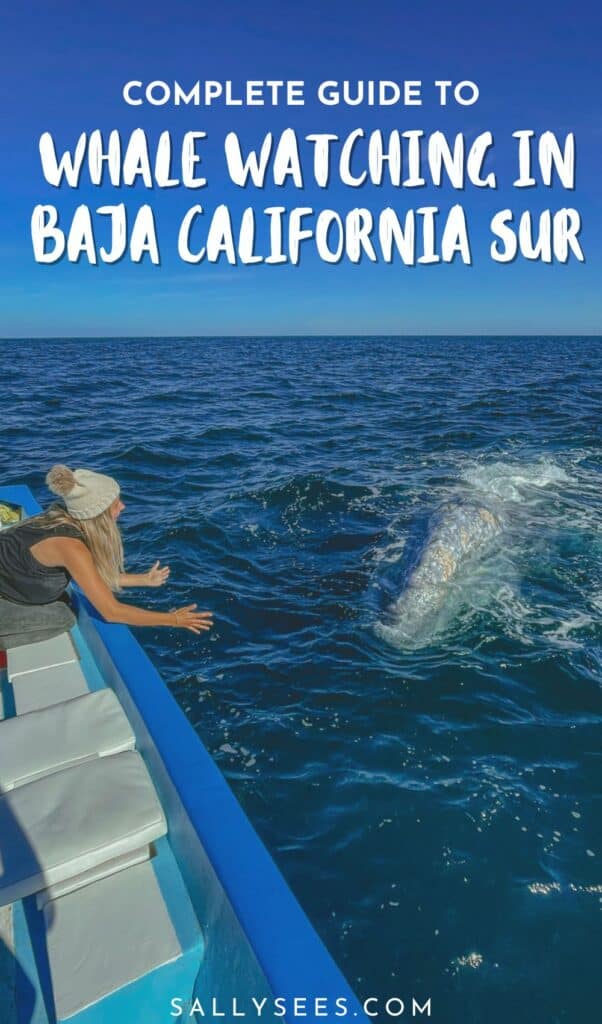
For reasons unknown by scientists, the grey whales that come to Baja each winter willingly approach boats and humans, and seek physical interaction. It’s not whale watching here, it’s more like whale playing.
The opportunity to safely and ethically touch and even kiss grey whales draws visitors from all over the world. And being able to physically connect with these incredible creatures is a once-in-a-lifetime experience.
The grey whales migrate south from the Arctic for the cooler winter months and come to Baja’s Pacific lagoons to mate, give birth and raise their young. The waters are warm and calm, and the bay is sheltered from predators like orcas found in the Pacific Ocean.
We personally visited Magdalena Bay, due to its proximity to other parts of the state. However, the northern lagoons of San Ignacio and Ojo de Liebre are just as popular, if not more so. Especially if you are driving down the peninsula from the US.
In Magdalena Bay, there are two main port towns (and a handful of smaller ones) that act as a jump-off point for grey whale watching tours. San Carlos (to the south) and Adolfo Lopez Mateo (to the north).
Where you depart from will generally depend on the tour company you are going with. We departed from San Carlos, and we have heard this is a better option than Adolfo Lopez Mateo, which can be busy and feel overwhelmed with tourists.
It is possible to do a single-day whale watching tour, but the location of Magdalena Bay makes it a very long day. It is around 3.5 hours from La Paz or 2 hours from Loreto, and whilst you will find plenty of tour companies offering these trips, we would suggest opting for a multi-day tour.
There are a number of tour operators that run camping/glamping experiences on the few small islands found in Magdalena Bay. Most offer all-inclusive packages that will include your accommodation at camp, all meals, and multiple whale watching tours out on the pangas with your experienced captain.
We opted for a multi-day experience with Magdalena Bay Whales, spending two nights glamping at their Island Whale Camp and one night at their hotel in San Carlos.
We couldn’t recommend them more highly. Not only was the glamping a unique experience that added to the magic of the grey whales. We also had two whale-watching trips on the panga boats into the bay. One time was not enough, and it was only on the second day that we found grey whales that were ready to play and interact.
The camping/glamping experience is also offered in the northern lagoons and we would highly recommend taking up this option. Who would have thought whale watching could get even MORE special!
- 🐋 Read more about grey whale watching in Magdalena Bay
- 🐋 Book our recommended grey whale watching tour

Blue whale watching
- 📍 Where: In the Bay of Loreto, with tours departing from either the Loreto Marina in town or from the Marina Puerto Escondido south of the city.
- 🗓️ When: February – March, can be mid-February depending on the year.
- 🚤 How: A single-day whale watching tour on a small panga boat, that generally runs for 4 – 6 hours.
- 📣 Tour Recommendation: For a shared tour, Loreto Sea and Land Tours offer great blue whale watching tours with qualified marine biologists. Alternatively, if you want a private boat for just your group, check out Loreto Blue Whales.


Blue whales are the largest animal in the entire world, growing up to 80 feet / 24 metres in length, and weighing in at over 150 tons. To put that into perspective, elephants, which are the largest land animals in the world, only weigh about 5 tons.
To see these ginormous creatures is absolutely mind-blowing.
Whilst they may not be as interactive as grey whales, or as acrobatic as humpback whales (I mean come on, what do you expect they weigh 150 tons!), seeing the sheer size of these creatures is equally impressive.
There is a lot less known about the blue whales, and why they come to Loreto. Many say it is to mate and give birth like the other species of whale in the area.
But that is not confirmed, and a lot of marine biologists believe it is purely to feed in the nutrient-rich waters of the Sea of Cortez.
The blue whales are the hardest whales to sight in Baja California Sur, and their migration period is very short. The official blue whale watching period is from February to the end of March. But in reality, it can be longer, it can be shorter.
We did our blue whale watching tour in Loreto on the 6th of February, and we were very lucky to spot five whales! However, we were in frequent contact with our tour company beforehand and were fully prepared to not be able to do the tour if they hadn’t sighted any whales by the time we wanted to go.
Due to their usual location in the Bay of Loreto, seeing the blue whales is quite straightforward. Allocate a day of your Loreto itinerary for a boat tour, which usually runs for around 4 – 6 hours.
- 🐋 Read more about blue whale watching in Loreto
- 🐋 Book our recommended blue whale watching tour

Humpback whale watching
- 📍 Where: Los Cabos, Todos Santos and Cabo Pulmo. Virtually all over the southern coast of Baja California Sur.
- 🗓️ When: December – April.
- 🚤 How: A single-day whale watching tour, most commonly departing from Los Cabos, but also possible from Cabo Pulmo. Local fishermen offer private whale-watching boat rentals in Todos Santos.
- 📣 Tour Recommendation: Cabo Trek is one of the only tour companies certified by the World Cetacean Alliance, ensuring their tours are ethical and follow the highest level of regulations. Whale Watch Cabo is another option that has a strong focus on conservation, and involvement in research projects.


Humpback whales are the most commonly spotted whales in Baja California Sur.
It is easy to see them directly from the beach, due to their active and acrobatic nature.
Humpback whales are known to jump out of the water (breach), smack their tails on the water (tail slap) and slap their pectoral fins (pec slap).
If you’re on the beach in Los Cabos, Todos Santos or Cabo Pulmo anytime from December – April, it’s almost guaranteed you will spot a humpback whale.
Keep your eyes peeled on the horizon, and you’ll no doubt spot spouts of water being blown into the air. And if you’re lucky, see a humpback whale put on a show for you!
But for a more up-close experience with the humpback whales, you can join a whale watching tour. These tours most commonly depart from Los Cabos (Cabo San Lucas and San Jose del Cabo).
The official humpback whale watching season in Los Cabos runs from 15 December – 15 April.
There are a variety of boat styles you can choose from. If you get seasick, it’s best to opt for a larger boat. But if you’re keen for a more unique, adventurous experience there are tours on inflatable zodiac boats too.
Tours generally last 3 – 4 hours.
Please be selective when choosing a tour operator to do your whale watching tour within Los Cabos. Because it is such a popular tourist area, there are countless companies offering humpback whale watching tours, and even more touts selling tours from the marina or beach.
Just because someone has a boat, doesn’t mean they should be offering a whale watching tour, or have the right training or skills to safely and ethically approach whales.
Whale watching is highly regulated in Los Cabos, and all of Mexico, but it doesn’t mean some companies don’t break the rules.
We can vouch for Cabo Trek and Whale Watch Cabo and are very impressed with their ethics and regulations.
- 🐋 Read more about humpback whale watching in Cabo
- 🐋 Book our recommended humpback whale watching tour

Swimming with whale sharks
- 📍 Where: In the Sea of Cortez off the coast of La Paz.
- 🗓️ When: The official season for swimming with whale sharks runs from 1 October – 30 April, but it depends on how many whales are actually present in the bay. The season will start late, pause during or finish early if there are not enough whale sharks.
- 🚤 How: A tour with a licensed operator, generally lasting 2 – 3 hours, to swim alongside the whale sharks.
- 📣 Tour Recommendations: If you are staying in Los Cabos and are looking for a day tour that departs from there, again we recommend Cabo Trek which is certified by the World Cetacean Alliance. They will transport you from Los Cabos to La Paz. If you are already in La Paz, Mexico Travel Adventure is a fantastic ecotourism company, that offers a swim with whale sharks experience.


Contrary to popular belief, whale sharks are not actually whales, they are sharks. Sharks are fish because they breathe underwater with gills, making whale sharks the largest fish in the sea!
Technically seeing whale sharks is not whale watching in Baja California Sur, but these incredible animals make the cut!
Although they grow up to 12 metres / 40 feet, there is no need to be afraid of these sharks! Considered the gentle giants of the sea, whale sharks pose no threat to humans, and they eat only small microorganisms like plankton and krill.
Each year from October – April, whale sharks come to the Sea of Cortez off the coast of La Paz, to feed on nutrient-rich waters.
La Paz is one of the few places in the world where you can swim with whale sharks.
Approved tour operators take small groups of tourists on boats into the ‘feeding zone’, where you are able to jump into the water with a snorkel and swim next to a whale shark.
The experience is tightly regulated by the government, and only a limited number of boats are permitted to enter the zone each day, for a maximum of three hours.
Only one boat is allowed to approach a whale shark, and a minimum distance must be kept. When you jump in the water, you will be accompanied by your mandatory guide, with a maximum of six snorkelers per group at one time.
There is no feeding or baiting going on, and overall the experience is ethical.
It can feel a bit rushed, as you are told to jump in the water quickly once your boat finds a whale shark. And when you’re in the water they swim very fast, so it can feel a bit hectic.
But in our experience, all the rules were followed and the whale sharks we spotted were feeding, indicating they were comfortable and not stressed.
- 🐋 Read more about swimming with whale sharks in La Paz
- 🐋 Book our recommended swimming with whale shark excursion

Final thoughts on Baja California whale watching
Whale watching in Baja California Sur, and being able to witness first-hand these incredible creatures up close, is one of our fondest travel memories.
I can’t think of anywhere else on earth with such rich marine life and an abundance of these giants of the sea.
Coordinating a trip to watch humpbacks leaping and playing in Los Cabos, touch grey whales in one of the lagoons, swim alongside whale sharks in La Paz and spy the blue whale, the largest creature to ever roam the earth, in Loreto is completely achievable in the magic whale heaven that is Baja!
Have you been whale watching before? Was it in Baja California Sur? What kind of whales did you see? Let me know in the comments!
Best of Baja California Sur
OUR BAJA CALIFORNIA SUR TRAVEL GUIDES





The Comments
Kris
El Jefe water taxi, recommended in your blog post on El Arco water taxi operators, took us out to see the whales as a little extra on our El Arco trip – amazing! I was a little dismayed at how close to the whales we all were, but we were very consistent with the others and El Jefe was great! Thanks for the great recommendations!
Kris
El Jefe water taxi, recommended in your blog post on El Arco water taxi operators, took us out to see the whales as a little extra on our El Arco trip – amazing! I was a little dismayed at how close to the whales we all were, but we were very consistent with the others and El Jefe was great! Thanks for the great recommendations!
Sally Rodrick
KrisHi Kris, seeing whales is always exciting! I’m glad they took you out, considering they are so close to El Arco! Yes, whale watching around Cabo can be a bit unregulated. That’s the problem with boat taxis and other non-related tours going out to the whales. They’re not trained (and don’t actually have the correct licensing from the Mexican Government) to offer these kinds of experiences ethically. But of course, when there are whales, you want to see them! So glad you enjoyed it. Sally
Suz
Hi! Going to BCS this weekend and trying to decide between seeing gray whales in Magdalena Bay and blue whales in Loreto – what would you recommend? We’ll have a camper van so don’t need accommodation.
Sally Rodrick
SuzHi Suz, the grey whales are incomparable. Their friendly and interactive nature is different to any other whale watching experience in the world! You can’t beat it. Head to Magdalena Bay, or if you’re already in the north you could check out Guerrero Negro or San Ignacio lagoons too 🙂 Enjoy! Sally
Francis
Thanks for all the amazing info! We want to go february 2024, do you recommend booking hotels and tours in advance? We thought it might be better not to book so we can stay longer if we have bad luck with the whale watching.
Sally Rodrick
FrancisHi Francis, it’s such a tough decision and one we always debate over. I love having flexibility and not locking in plans, but the flip side is that you may miss out on things if they get booked out. February is a bit better than December/January in terms of crowds, but it’s still peak season. I’d suggest booking in your key experiences and accommodations, but maybe leaving a few days buffer in between. There’s never any guarantee with wildlife, but February is a prime month and there is A LOT of whales in Baja, so I think you’d be unlucky to need a second go. We saw blue whales in Loreto, humpbacks in Cabo, whale sharks in La Paz and of course grey whales in Magdalena Bay. The only thing that may possibly happen is that you see grey whales, but they’re not in a friendly, interactive mood. I’d suggest staying overnight (or 2 – 3 nights) at the Mag Bay whale camp regardless, because it’s such a great experience, and you’ll have multiple whale watching tours included. Enjoy it! Sally