This article contains affiliate links that may earn me a small commission at no extra cost to you. As an Amazon Associate, I earn from qualifying purchases. For more information, see our affiliate disclaimer.
One of the most common questions I get asked about Central America is how to navigate the situation of drones in Nicaragua.
Drones are not allowed in Nicaragua. In our experience, there’s no way of getting around this.
If you’re just travelling to Nicaragua, it’s simple – you don’t bring a drone.
But if you’re travelling to any of the other 6 countries in Central America, Mexico or South America on the same trip, you probably want to bring your drone! It’s legal to use it in many other countries, and it’s frustrating to leave it at home for a small portion of a larger trip.
We were in the same boat and really wanted to bring our drone during our 6-month trip to Central America, but we had to work out what to do with it when we reached Nicaragua.
This brief post is the solution we came to, which hopefully will help you deal with the issue of drones in Nicaragua.
This was purely our experience, and the laws around drones and other camera equipment may change in the future, so please don’t take this as your only advice. If in doubt, check directly with the Nicaraguan immigration department.
Drones in Nicaragua – what’s the deal?
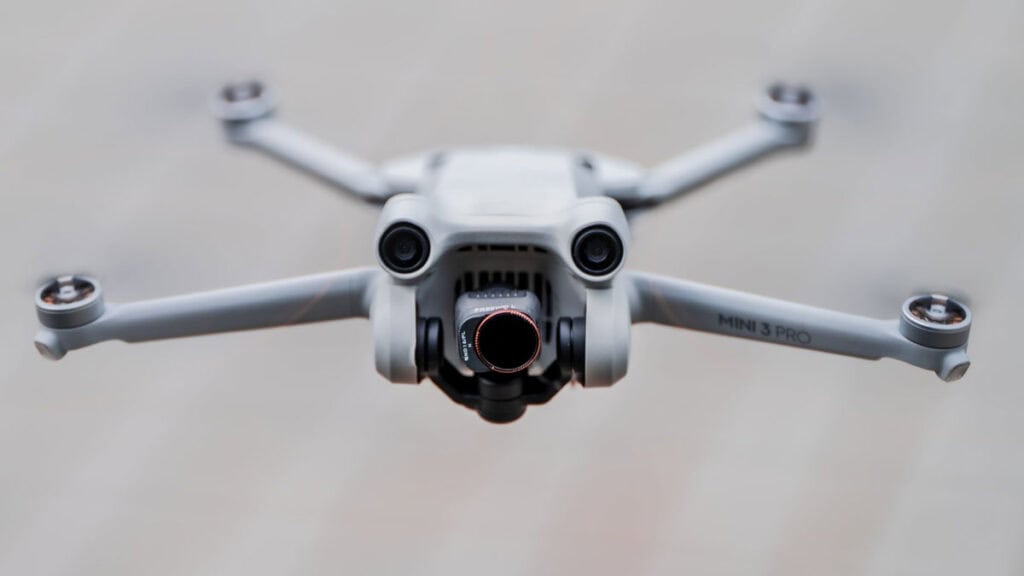
Drones are not allowed in Nicaragua.
I don’t know the exact reason for this, but there are speculations it is to prevent the filming and distribution of protests or human rights abuses.
Nicaragua has an authoritarian / dictator government that is paranoid about any anti-government messaging. They censor the media and take swift action on anyone who is seen to not be supporting the government.
When I say drones are not allowed, I don’t mean that you’re not allowed to fly them. They are not allowed to be brought into the country, full stop, whether you’re a foreigner or a local.
You might be thinking that there is a way around this, but in our experience, there’s not. Whether you’re flying into Nicaragua via the international airport in Managua or crossing a land border from El Salvador, Honduras or Costa Rica, you can’t bring a drone into Nicaragua.
We heard stories of people bribing their shuttle drivers to hide it, or putting their drones in chip packets to conceal it. I really don’t think this would work. They take this rule very seriously, and as travel with drones has become more popular, they’ve clamped down even more.
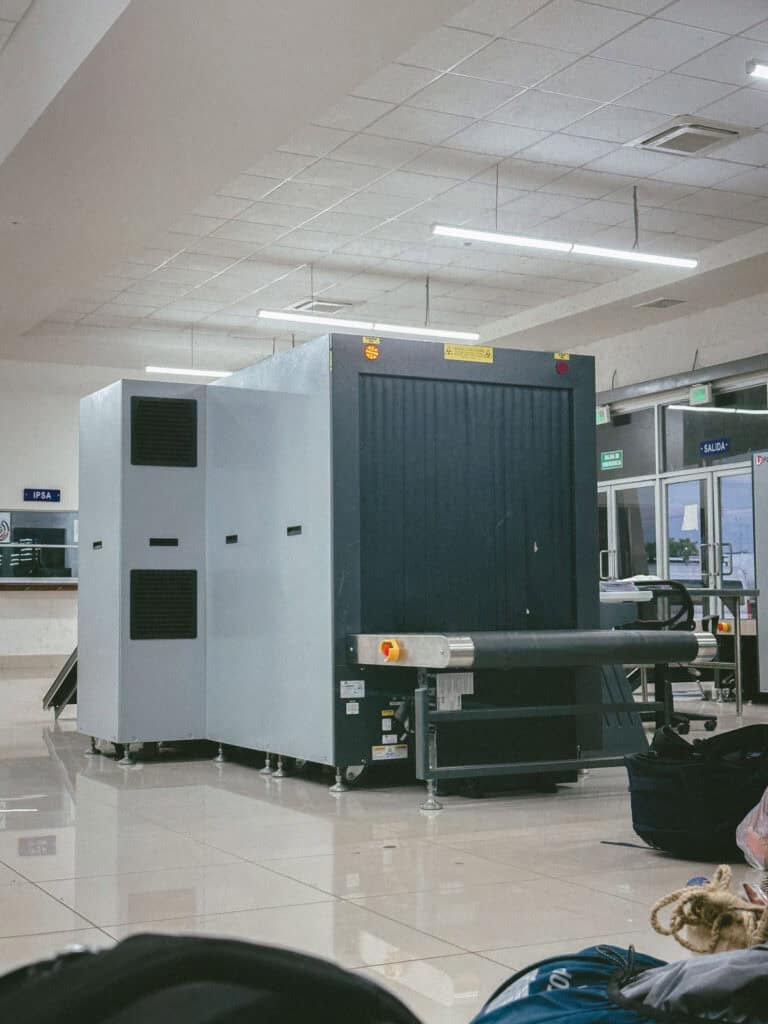
We spent more than 3 hours sitting at the border when crossing from El Tunco – Leon, while our shuttle van was searched from top to bottom. Our luggage was scanned through X-rays and manually searched.
There was no way a drone was getting through, at least not on the day we crossed the border.
What is the consequence of bringing a drone?
If you want to run the gauntlet and try and bring or sneak a drone into Nicaragua, it will most likely be confiscated.
I had read that the immigration department may ship your drone to your port of exit (i.e. the airport in Managua or another land border) and charge a storage fee.
However I am not confident that you would actually get the drone back, and I think it would require a lot of painful administration (in Spanish) and a lot of bribes.
Knowing what I know about how Nicaragua operates, you do not want any more dealings with their government/administrative functions than absolutely necessary. It only ends in frustration, wasted time and an empty wallet.
We decided it wasn’t worth the risk or hassle to try and bring in a drone and pick it up when we departed.
What about cameras?
For a brief period in 2023, the Nicaraguan Government also banned any cameras, lenses, binoculars or other photographic equipment being brought into the country.
This rule only lasted a few days though, as there was a massive uproar and they reverted their decision.
As far as I know, at the time of writing (2026), cameras can be brought into Nicaragua.
I travel with a Sony a7iii mirrorless camera and a pretty large lens, plus a GoPro and I had no problem at the border. The agents looked closely at each of them and asked me about a drone, but the camera was not a problem.
I think binoculars are still a no-no (which doesn’t really make any sense) and if you have a seriously professionally looking kit of video cameras and/or really big telephoto lenses, you may have issues. But if you’re just a regular traveller with a DSLR / mirrorless camera and a lens or two, I don’t think you will have any problems.
Our drone solution
We were travelling south through Central America following this route:
Belize 🇧🇿 > Guatemala 🇬🇹 > Honduras 🇭🇳 > El Salvador 🇸🇻 > Nicaragua 🇳🇮 > Costa Rica 🇨🇷 > Panama 🇵🇦
It took a lot of research, deliberation and stress to work out what to do with the drone.
We tossed up flying from El Salvador to Costa Rica, dropping off the drone, and then backtracking via land to Nicaragua. We thought about trying to find someone who was flying this route to take the drone with them. We considered just giving up and posting the drone home to Australia, or storing it in El Salvador and picking it up later in our trip.
We never considered skipping Nicaragua, but I know a lot of people don’t visit the country for this reason.
Eventually, we came up with a solution that turned out to be so simple, not disruptive to our travel route and not that expensive either!
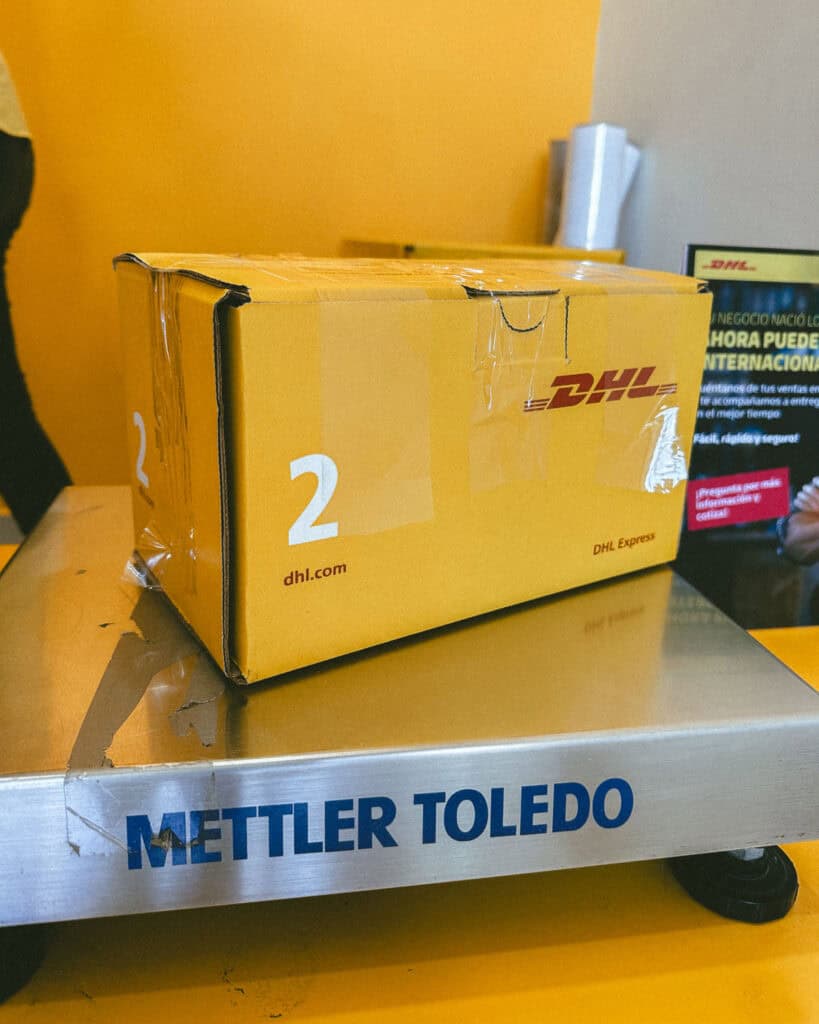
We posted the drone from El Salvador – Costa Rica with DHL.
This plan requires you to have somewhere to post to in Costa Rica (or in El Salvador if you’re travelling in the opposite direction). I’ve since learned that you can actually just ship it to another DHL store and they will hold it for you, apparently for no extra fee, making this plan even easier!
We had already organised a month-long car rental with Nomad America so we reached out and asked if they would be happy to receive the drone.
If you are sending it to a hostel, car rental company etc., you’ll need their address (best to ask them what to write instead of what Google says, they use funny addresses in Latin America!), contact phone number and email for the shipment. If you’re just sending it to another DHL branch, then the staff can help you complete these details.
Posting our drone
If you’re not already aware, the local postal systems in Central America are unreliable at best and non-existent at worst.
We spent a while looking for an international shipping company that would be reliable enough to send the drone with.
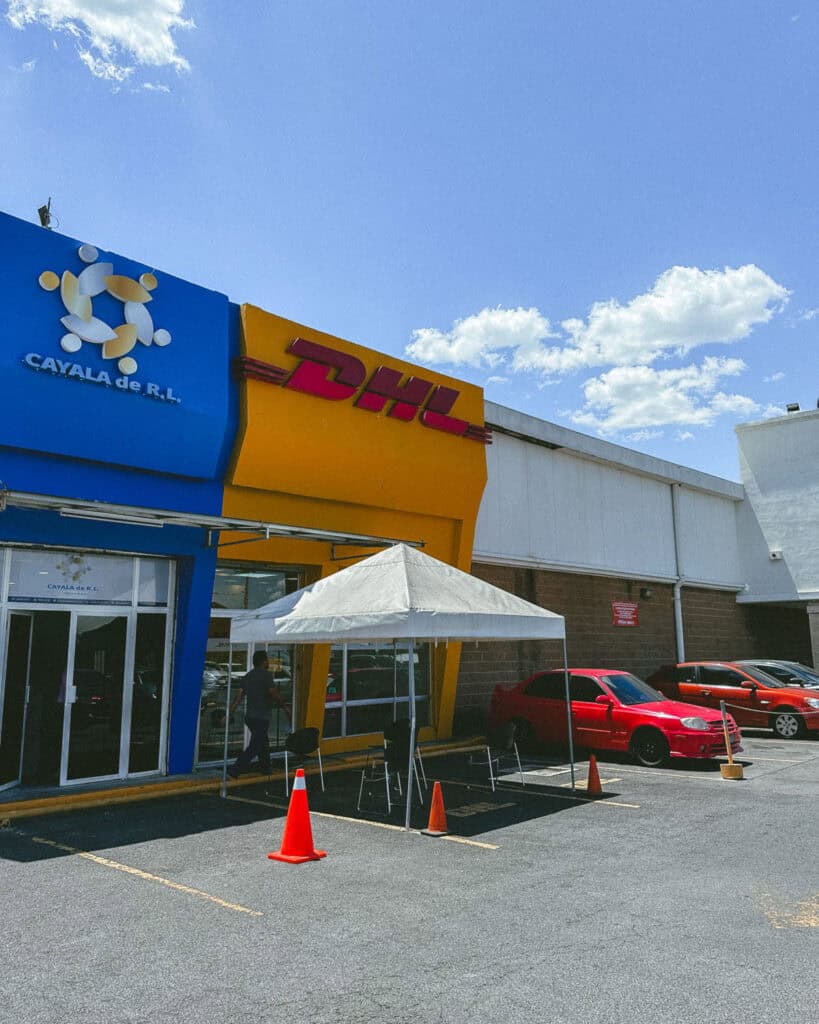
We decided that DHL was the best option. We were in El Salvador, and the nearest location was in San Salvador.
If you’re travelling in the opposite direction, there are lots of DHL branches around Costa Rica. Most are in the capital San Jose but I believe they are more widespread around the country and you might be lucky enough to find one in a tourist destination, saving yourself an unnecessary trip to the capital.
We weren’t planning to visit El Salvador’s capital, San Salvador, but we took the bus from El Tunco for the day, and it was surprisingly easy. It’s only an hour by bus, and once you’re in the city you can easily use Uber to get around.
We went to the ‘Terrazas’ branch in the city, next to Office Depot. This is the exact location. We got super lost trying to walk there, so I’d recommend putting the address into Uber and not getting out until you’re at the door!
The lady was very friendly and helpful and although she didn’t speak English, she was patient while we explained what we needed in Spanish.
She helped us fill in the address and contact details of Nomad America, and she needed some information about what was going into the package and what its value was (we just guessed a number but I’d recommend making it on the lower end, in case you get charged import taxes, more on that below).
We were not able to post the drone batteries. This was considered hazardous and DHL wouldn’t ship it. We sent the drone and controller but we kept the batteries and battery charger with us. We explained this at the border in Nicaragua and also advised our shuttle driver of this when we got on in case he needed to explain it to the border agents. We kept the itemised receipt of the shipment from DHL as well as photos of the package with our drone and controller inside the box to prove we had shipped the actual drone. We had no problems.
It cost us $79 USD to ship, and we got a tracking number so we could follow the journey. I’m sure it will be slightly more expensive now, but it’s hardly prohibitive and much cheaper than rearranging your entire travel plans!
She boxed up the drone and told us it would arrive the following day. All that stress for one day of travel!
It ended up arriving two days later in Costa Rica and was safely received by Nomad America. They had it waiting for us when we picked up the car 5+ weeks later. If you ship to DHL, they can hold it for you until you arrive in Costa Rica.
Easy, hey?
Import taxes
The only hiccup in our plan was that DHL emailed us while we were in Costa Rica, trying to charge us some kind of tax for the drone.
It was close to 7 or 8 weeks after the drone had arrived in the country and Nomad America received the delivery, which we found odd.
I can’t recall the exact wording they used, but we think they were trying to make us pay an import tax. We replied and explained that it wasn’t a new product, we were just sending a personal item to ourselves from another country (I’ve since come to understand that this doesn’t really matter and import taxes apply on used goods too, but playing dumb helped here!).
I think they replied to our email once, we replied back stressing again that it was our item and then we never heard from them again. We didn’t pay anything.
I’m not really sure about the official rules or regulations on this, but the lady at DHL in El Salvador didn’t say anything about it. I’d recommend asking when you ship it, just to be sure.
I think the import tax in Costa Rica is anywhere from 0 – 15% of the value of the item, so worst case you do get charged, I don’t think it would be a ton. It’s probably wise to write a lower number when you’re asked to include the value of the items on the shipping form.
I’m not sure what the situation would be posting from Costa Rica – El Salvador.
Nicaragua travel information
If you’re planning a trip to Nicaragua, you need to read my Nicaragua travel guide. I cover everything you need to know – when is the best time to visit Nicaragua? Is it safe? What’s the currency and money situation? How do I get around?
If you’re wondering how much it costs to travel in Nicaragua, check out our Nicaragua travel budget post, which includes our complete budget breakdown and samples of typical travel costs.
Drones in Nicaragua: Solution
I hope our experience handling the situation with drones in Nicaragua is helpful!
This is purely what we did, I can’t guarantee this is the most current or proper legal advice. Rules and enforcement of those rules are changing all the time, so I don’t know if this will always be the best method for navigating the ban on drones in Nicaragua, but it worked for us.
Nicaragua is absolutely worth visiting and you shouldn’t skip it during your Central America route, for the sake of a drone.
MORE NICARAGUA POSTS
- Nicaragua Travel Guide: Land of Lakes and Volcanoes
- 1 Month Nicaragua Itinerary: Experience the Best of Nica
- Our Nicaragua Travel Cost: Is Nicaragua Cheap?