
This article contains affiliate links that may earn me a small commission at no extra cost to you. As an Amazon Associate, I earn from qualifying purchases. For more information, see our affiliate disclaimer.
Panama is hands down the most underrated destination in Central America. Most people only know it for its canal, but this beautiful country has so much more to offer.
Panama is the natural land bridge between Central and South America and a narrow isthmus between the Pacific Ocean and the Caribbean Sea, resulting in one of the most biodiverse countries on earth.
We spent four weeks travelling in Panama as part of a 6-month trip through Central America and loved every minute of it. There truly wasn’t a bad part to our time here and every destination we visited was unique, offering something new and different to the last.
We fell in love with Panama City with its historic old town and glistening modern skyline. We found tropical heaven in Bocas del Toro and the San Blas Islands and loved hiking through the misty cloud forests of Boquete and the extinct volcanic crater of El Valle de Anton.
In this Panama travel guide, I’ll share the best places to visit and top things to do, how to get to and around the country, as well as handy travel info like entry requirements, money matters and phones and SIM cards.


Why visit Panama?
After travelling through all seven countries in Central America, I think Panama is one of the most underrated! So many people skip over Panama in favour of neighbouring Costa Rica or visit only as a stopover en route to somewhere else, which I think is so sad.
It was the final stop of our 6-month trip and definitely one of the highlights. There are so many reasons why you should visit Panama, whether it’s part of a broader trip through Latin America or as your primary destination.
- 😌 Undiscovered and underrated gem: Panama is far less popular than its neighbour Costa Rica, despite sharing very similar characteristics and landscapes. Tourists do visit Panama, but the vast majority stick only to the capital city, leaving the rest of the country relatively quiet and undiscovered, without huge crowds.
- 🌿 A taste of everything: tropical Caribbean islands, barrelling surf on the Pacific Coast, lush cloud forests in the highlands, extinct volcanic calderas, charming colonial towns and modern megacities, a trip to Panama has a bit of everything!
- 🏝️ Paradaisacal islands: if you’re a tropical lover like me, you will fall in love with Panama’s Caribbean islands. Both Bocas del Toro and the San Blas (Guna Yala) Islands are like something on a postcard.
- 🦥 Biodiversity hotspot: Panama is the natural land bridge between North and South America, and the narrow isthmus lies between the Pacific Ocean and the Caribbean Sea. Its strategic location has created a biodiversity hotspot, with an astounding amount of plant and animal life. It’s one of the most biodiverse countries in the world. Costa Rica gets all the credit for wildlife, but Panama has just as much, if not more. We saw a sloth in the capital city – where else in the world can you do that?
- 🏙️ Cosmopolitan capital: capital cities in Central America are mostly seedy, unsafe and best avoided. That all changes in Panama! Panama City is one of the greatest capitals in Latin America. A sultry, tropical vibe with an old-meets-new clash of rich colonial history and modern developments, it’s an incredible city.


Is Panama safe to travel?
Panama is generally one of the safer countries to visit in Latin America, with the exception of a few areas. We spent almost a month travelling around the country and never had any problems, I can’t recall a time when I even felt slightly uncomfortable!
Government travel advice from the United States, Australia and New Zealand has Panama at risk level 2 – exercise a high degree of caution with higher levels for certain areas. Canada rates Panama as level 1 – exercise normal safety precautions.
One major no-go zone in Panama is the Darien Gap, which is the wild and remote section of jungle on the Panama and Colombia border. It’s frequently used as a drug and human trafficking route, with a lot of narco activity. It’s not somewhere you’d be likely to travel anyway, as there are no roads or amenities.
It’s also recommended to avoid the Mosquito Gulf on the mid-northern Caribbean Coast, and while there is not a strict warning not to visit, the city and province of Colon are a bit seedy too.
Panama City as a whole is a safe city, but there are certain areas you shouldn’t visit. Most tourists base themselves in the historic Casco Viejo neighbourhood which is generally safe but is closely bordered by some sketchy neighbourhoods like El Chorrillo and Santa Ana. I’ve got more info about staying safe in Casco Viejo in my guide.
We travelled by public bus all over the country with no problems. The transport in Panama doesn’t have the same risk as neighbouring countries.
The only other safety concern we had was on certain hiking trails. It’s always best to check in with park rangers or your accommodation before setting off on any hikes without a guide, as non-violent robberies can occur. The India Dormida trail in El Valle de Anton is one example. It’s not a widespread problem, but best to check the latest reviews on AllTrails and get the updated information on the ground.
Language in Panama
As with most countries in Central America, Spanish is the official language in Panama.
A handful of Indigenous languages are spoken throughout Panama as well, mostly in their respective comarca indígena or Indigenous district.
In some touristy areas, like parts of Panama City and Bocas del Toro, some English is spoken, but you should never assume.
Brush up on your Spanish and have the Google Translate app at the ready!

Best time to visit Panama
Panama has a hot and tropical climate, sitting between 7° and 10° north of the equator.
It mostly follows the standard Central American wet/dry season, although the climate varies across the country on either coast.
The dry season (high tourist season) is typically from November to April and the wet season (low tourist season) is from May to October.
The Pacific Coast tends to follow these seasons more rigidly, and the dry season is mostly sunny and free of rain.
The Caribbean Coast has a more tropical climate with a chance of rain year-round. The dry season kicks off a little later, usually mid-January until April, and the region also experiences a second mini-dry season in September and October.
Boquete and other highland areas are slightly cooler, and generally wetter year-round too. This means lush cloud forest and beautiful, moist greenery, so don’t be put off!
The safest bet for warm, dry weather is the peak of the dry season from around February – mid-April. Skip Christmas, New Year and Semana Santa (Easter) if you can, as these are the busiest periods for international and domestic travel.
🌞 I think February to mid-April is the best time to visit Panama for warm, sunny days, good visibility, a low chance of rain and fewer crowds

Places to visit in Panama
Panama has dozens of beautiful places to visit and we only scratched the surface during our month in the country.
- 🌆 Panama City: Panama’s trendy capital is a seamless blend of historic charm and contemporary glamour. With a glistening skyline in the modern city, cobblestone streets and restored colonial mansions in Casco Viejo and nature on its doorstep, don’t overlook Panama City.

- 🏖️ Bocas del Toro: the island hotspot of Panama, the Bocas del Toro archipelago is a collection of nine main islands and dozens of cayes and islets on the northern Caribbean Coast. With surf, jungle adventures, snorkelling, scuba, and sun and sand on some of the country’s best beaches, there is something for everyone. Each island caters to a different kind of traveller, from partying backpackers to romantic couples getaways.

- 🌿 Boquete: sitting in the highlands of the Chiriquí Province, Boquete’s cool climate, moist green cloud forests and rolling coffee plantations are a haven for hikers and nature lovers. Ascend to Panama’s highest point, Volcan Baru, at sunrise, trek along muddy trails to hidden waterfalls and try a cup of locally grown Geisha coffee, some of the world’s finest beans.

- 🏝️ San Blas Islands: correctly known as the Guna Yala Islands, this archipelago in the Caribbean is what Castaway dreams are made of. 365 islands and cayes with white sandy beaches and groves of palm trees are dotted amongst turquoise waters filled with starfish. Populated by the Indigenous Guna people, these islands are a rustic, no-frills destination offering the chance to completely disconnect from modern life. A day tour from Panama City is possible, but don’t cheat yourself – you’ll want to spend at least a few days in this paradise!

- 🥾 El Valle de Anton: the biggest town in the world set up inside an extinct volcanic crater, El Valle, as it’s affectionately known, is a hiker’s heaven. Trails crisscross the rolling grassy hills along the rim of the crater, with dense forest, waterfalls and thermal springs in the valley below. I’d highly recommend spending a few days here if you want to do some hiking, but if you’re short on time, it’s possible to visit on a day tour from Panama City.

- 🤿 Santa Catalina: one of Panama’s top surf destinations, Santa Catalina has dual appeal, also offering the closest land access point to an underwater paradise known as the Galapagos of Panama, Coiba Island. Whether you’re into surfing, scuba or both, this laidback fishing village delivers.

- ⚓️ Portobelo: located in the Colon province on the Caribbean Coast, Portobelo was once the country’s most important port. Today it’s one of the best places to explore the rich African culture of Panama.

- 🏄🏽♂️ Playa Venao: an alternative surf destination, Venao is set on a long strip of golden sand on the Azuero Peninsula. The waves aren’t quite as good as Santa Catalina, but the town is certainly more happening, with a buzzing nightlife scene and trendy hostels, cafes and restaurants.

Top things to do in Panama
There are so many fantastic things to do in Panama. I’ve listed many in my specific destination articles, but if you’re wondering what are the absolute top, bucket list experiences that you should plan your trip around, here’s my top 10!
- 🦈 Snorkel or scuba dive at Coiba Island: one of the most pristine and biodiverse marine ecosystems in the region, if you’re looking to swim amongst sharks, turtles, rays and even whale sharks at certain times of the year, Coiba Island is the spot. A former penal colony, the island and surrounding archipelago is known as the Galapagos of Panama and is teeming with life above and below the surface.
- 💦 Hike to The Lost Waterfalls in Boquete: the damp cloud forests of Boquete are full of fantastic hiking trails, but none better than The Lost Waterfalls. Leading through dense forest, dripping with vines, mosses and lichens, to three stunning waterfalls, it’s one of the best hikes in the country.
- 🏝️ Spend the night on Chichime Island: there are hundreds of islands to visit in the San Blas Islands archipelago, but our choice to bliss out for a few days on Chichime Island was a good one. Wide, sandy beaches, vibrant waters and a grove of palm trees, with a friendly Guna family taking care of the well-run cabanas, it’s heaven on earth.


- ⛪️ Stroll the charming historic district of Casco Viejo: cobblestone streets, restored colonial mansions, cosy cafes and leafy rooftop bars, we adored Casco Viejo. This trendy neighbourhood is the place to be in Panama City, oozing with historic charm, excellent eateries and gorgeous boutique hotels. Join a walking tour to learn more about the culture and history of the neighbourhood, or consider this alternative walking tour that unravels the impacts the gentrification of this area has had on locals.
- 🌋 Walk along the rim of a volcanic crater: it’s inactive, so don’t worry! El Valle de Anton is a town inside a crater, and hiking on the trails on the rim above the town is a unique experience and landscape like no other in Panama! Cerro Cara Iguana and Cerro La Silla are two excellent trail options.
- 🐚 Stay in an overwater bungalow in Bocas del Toro: the jungle-clad islands of Bocas del Toro offer a range of amazing accommodations, including the very unique experience of staying in an overwater bungalow, with direct access to beautiful Caribbean waters!


- 🚢 Visit the Panama Canal: one of the world’s greatest engineering feats, no visit to Panama is complete without a look at the famous Panama Canal. You can get the gist with a brief visit to the Miraflores Locks in Panama City, but if you’re an engineering buff, you can take a full transit or partial transit through the canal onboard a ship!
- 🦦 Float through a canyon: one of the coolest and most unexpected sights we saw in Panama was Los Cangilones de Gualaca. Located near Boquete, this naturally formed canyon in the Río Estí is the ultimate spot for cliff-jumping and riding the current through nature’s version of a lazy river.
- 🏖️ Laze on Panama’s best beaches: with over 1,800 miles of Pacific and Caribbean coastline Panama has some seriously stunning beaches. None more picturesque than the beaches of Bocas del Toro. There’s a beach for everyone here, from the calm waters of Playa de Estrella, full of starfish, to the jungle-backed Red Frog Beach, home to (you guessed it!) tiny red strawberry poison dart frogs, or the idyllic sands of the remote and untouched Cayos Zapatillas, the options are endless.
- 🦥 Look for wildlife: an activity for anywhere you go in Panama, you should always have your eyes peeled for wildlife. Sloths and monkeys live in the urban forests in Panama City, this should give you an idea of how much wildlife there is in this country! From the endemic golden frogs to the rare and majestic harpy eagle, there are feathered, scaled and furry friends all over the country. Look out for the elusive resplendent quetzal on the Pipeline Trail in Boquete.


Visas and immigration to enter Panama
Citizens of many nationalities can enter Panama without a visa for tourism purposes for up to 90 days.
There are no entry fees for Panama (unless you arrive by boat, which isn’t uncommon for travellers coming from Colombia, your sailing company will take care of this), you just need a valid passport with 6 months remaining. You may be asked to show evidence of funds up to $500 USD as well as proof of onward travel or a return flight ticket.
If you’re travelling through the region long-term with no fixed onward travel plans or departure flights, this can be problematic.
Panama was the final stop of our trip through Central America, and by the time we entered, we did have a genuine flight booking out of Panama City. They asked to see evidence of this at the border.
If you’re just starting your trip or planning to depart the country via land or sea, you can use a service like Onward Ticket, which instantly books you a real flight ticket for just a few bucks, and automatically cancels the booking after 48 hours. You don’t have to pay the full amount for the flight, just their service fee (currently $16).
I don’t recall completing a customs form when I arrived, but I believe they have now started doing a digital customs declaration form.

Getting to Panama
✈️ BY AIR
Panama only has one major international airport, the PTY – Tocumen International Airport in Panama City. A few other airports around the country have the ‘international’ label, but they only receive flights from Costa Rica.
Depending on how your Panama itinerary is structured, you can connect with a domestic flight after landing to start your trip elsewhere, like Bocas del Toro. There are a small number of domestic flights from Tocumen International Airport, but you need to factor in a transfer to the PAC – Albrook Gelabert Airport on the other side of the city, which is where most domestic flights depart from.
🚌 BY LAND
If you’re already travelling in Central America, you can easily cross into Panama from Costa Rica. There are two major crossings, one in the west on the Pacific Coast and one in the east on the Caribbean Coast.
- 🇨🇷 From Costa Rica (west): if you’re travelling down the Pacific Coast of Costa Rica, you can cross the border at Paso Canoas. Buses run down the Panamerican Highway on the Costa Rica side, from destinations like Uvita, Drake Bay and other towns on the Osa Peninsula. After crossing, your most likely destination in Panama is Boquete. Instead of taking a series of buses, you can pick up a tourist shuttle at the border to take you directly to Boquete (book here).
- 🇨🇷From Costa Rica (east): if you’re finishing up your time in Costa Rica in Puerto Viejo and the Caribbean Coast, it’s a very easy trip to Bocas del Toro in Panama. If you’re feeling lazy, the quickest way is to book a door-to-door shuttle from your accommodation in Costa Rica to Isla Colon in Bocas (book here). Alternatively, you can use public transport to get a bus to the border in Sixaola, pick up a bus to Almirante on the Panama side, and get a water taxi to the islands (more specific info on how to do this trip in my Bocas del Toro guide).
⛵️ BY BOAT
If you’re travelling from South America, a very common way to arrive in Panama is by boat, via the San Blas Islands.
Most sailing trips depart from Cartagena in Colombia and sail to the Caribbean Coast in Panama over 5 days, including a few days island hopping around the archipelago.
There are speedboat trips that hug the coastline and don’t require an open ocean crossing. These depart from Sapzurro or Capurgana in Colombia.
No matter which option you choose, your trip will most likely end with a transfer to Panama City.
Getting around Panama
Panama is a relatively straightforward country to get around. It’s very thin, and the Panamerican Highway runs the length of the country in the west.
- 🚐 Tourist shuttles: tourist shuttles are by far the quickest and most convenient way to travel around Panama. They’re usually minivans, and they shuttle tourists directly between popular destinations, with few or no stops in between.
They’re not necessary for every destination, but they’re very helpful in the north of the country for places like Bocas del Toro, Boquete and Santa Catalina that are off the Panamerican Highway and would require multiple bus changes to travel between.
We used Bookaway to book shuttles in Panama. You can get 5% off your booking with code SALLY5.
- ✈️ Flights: air travel is a feasible way to get around Panama. It’s very common for travellers to fly from Panama City to Bocas del Toro or David (for Boquete) to avoid a lengthy bus ride, at least one way. If you’re not travelling to Panama from Costa Rica, I’d recommend at least one domestic flight to create a one-way travel route. The country is too narrow for a loop!
- 🚌 Bus: Panama has quite an extensive bus network. I wouldn’t say they are chicken buses, like the bright, funky old school buses they have in Guatemala and El Salvador. It’s a mix of modern coach buses, older school buses and colectivo vans. You can pretty much get a bus (or a combination of buses) anywhere you want to go, the problem is you can’t see routes, timetables or book online.
From Panama City, buses depart from the Gran Terminal Nacional De Transporte, outside the Albrook Mall. It’s hectic with hundreds of booths selling tickets to wherever you want to go, but you can find the info you need. If you’re coming from somewhere else, it’s a little harder to work out where to go, what bus to take and at what time, but asking around at your accommodation and some Googling will usually get you the answer.
I’ve tried to include as specific details as possible in my destination guides about getting to/from those places by bus.
- 🚐 Colectivo: once you’re in a town, colectivo (shared) vans are your best bet for getting around to nearby attractions, trailheads etc. They’re very informal, you won’t find timetables or routes online, but again, I’ve tried to include as specific details as possible for using colectivos in different towns, mostly Boquete and El Valle de Anton.
- 🚙 Uber: Uber is available in Panama City and David. It’s plentiful and cheap and is a great way to travel around the city, and much quicker than using the metro or city bus system.
- 🚕 Taxi: taxis are available in all cities and towns. If you can use Uber (only in Panama City and David), I’d suggest that as they are cheaper and more convenient (and can’t rip you off!), but taxis are always available. Be sure to agree on a price in advance as meters are not used.
- 🚗 Rental car: a lot of people rent a car to road trip through Panama. I think this would be a great way to see the country, and except for Panama City, driving was pretty straightforward. The only problem is that the shape of Panama as an isthmus means a one-way rental is more suitable, and a round-trip rental would require a lot of backtracking. One-way rentals can be expensive or impossible depending on who you rent with, which is something to factor in. Renting a car when you arrive at each destination and using buses or planes to travel between places can be a solution to this. Browse for rental cars in Panama.
- 🚤 Boat: in Bocas del Toro, you will travel primarily by boat. They’re often called water taxis, and ply certain routes between islands.


Panama travel routes
I think the best way to see Panama is a one-way route from north to south or vice versa.
We travelled across the border from Costa Rica, so we naturally travelled one-way south in a very linear route and flew out of Panama City. If you’re coming north from Colombia, you will be able to achieve the same thing in reverse, sailing via the San Blas Islands.
If you’re flying in and out of Panama City, I’d recommend taking one domestic flight to Bocas del Toro at the start of your trip, and then working your way back overland to Panama City. Or vice versa, flying out of Bocas del Toro at the end.
To see the highlights across a broad range of destinations, I think you need at least 3 weeks, 4 weeks would be more leisurely. If you’ve got 2 weeks or less, you would need to start making choices (Boquete vs El Valle de Anton for hiking, Santa Catalina vs San Blas Island vs Bocas del Toro for beach time).
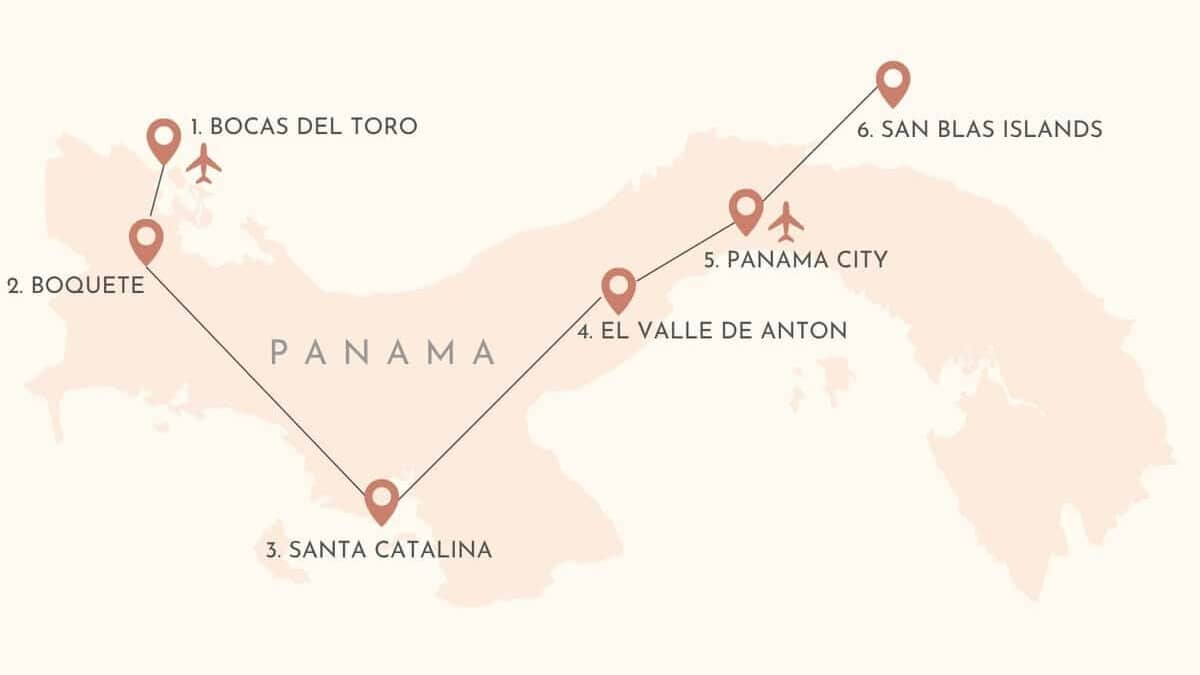
I’ve got an in-depth Panama itinerary post with more details, but this is my recommended order (or reverse).
3 – 4 week Panama itinerary
- 🏖️ Bocas del Toro: 4 – 6 nights
- 🌿 Boquete: 4 – 6 nights
- 🏄🏽♂️ Santa Catalina: 3 – 4 nights
- 🥾 El Valle de Anton: 3 – 4 nights
- 🏙️ Panama City: 4 – 6 nights
- 🌴 San Blas Islands: 2 – 3 nights
🗺️ Copy our exact Panama itinerary
Accommodation in Panama
You can find accommodations of all styles and budgets around Panama.
We didn’t have any trouble finding good quality accommodation for our usual budget (~ $50 – $60 USD per night), and we had kitchen facilities in every place we stayed.
If you want to splurge, there are some incredible overwater bungalows in Bocas del Toro, and the quality of the historic boutique hotels in Casco Viejo in Panama City is next level!
If you’re on a budget, there are some fantastic hostels around the country. Bambuda in particular is a great Panamanian hostel chain with some unique, lodge-style properties in beautiful locations.
Accommodation in the San Blas (Guna Yala) Islands is generally booked as part of a package with a specialised agency, so you won’t see any specific recommendations for San Blas here.
🏩 Some top boutique options in Panama (at mid-range and high-end prices):
- Amarla Boutique Hotel, Casco Viejo, Panama City
- Las Clementinas, Casco Viejo, Panama City
- American Trade Hotel, Casco Viejo, Panama City
- Nayara Resort, Isla San Cristobal, Bocas del Toro
- Sol Bungalows, Isla Solarte, Bocas del Toro
- La Loma Jungle Lodge, Isla Bastimentos, Bocas del Toro
- La Coralina Island House, Isla Colon, Bocas del Toro
- Hotel Panamonte, Boquete
- Valle Escondido Wellness Resort, Boquete
- Villa Coco, Santa Catalina
- Hotel Santa Catalina, Santa Catalina
- The Golden Frog Inn, El Valle de Anton
- Nomada Republic Hotel, El Valle de Anton
🛏️ Some top hostels around Panama:
- Magnolia Inn, Casco Viejo, Panama City
- Viajero Casco Viejo Hostel, Casco Viejo, Panama City
- Bodhi, Panama City
- Bambuda Lodge, Isla Solarte, Bocas del Toro
- Skully’s House, Isla Colon, Bocas del Toro
- Bambuda Bocas Town, Isla Colon, Bocas del Toro
- The Lost & Found Hostel, Chiriqui
- Bambuda Castle, Boquete
- ONDA Boquete, Boquete
- Bodhi, Santa Catalina
- Bambuda, Santa Catalina
- Bodhi, El Valle de Anton


Money in Panama
The official currency of Panama is the Panamanian Balboa (PAB, also ฿, B/).
However, the Balboa is tied at a fixed rate of 1:1 with the US Dollar ($1 Balboa = $1 USD).
Panama does not print Balboa notes, so the US Dollar notes are used.
There are Balboa coins in 1, 5, 10, 25 and 50 centésimos (cents) and $1 Balboa.
Essentially Panama uses the US Dollar, but just expect that you might get small change back in Balboa coins.
Prices quoted might be listed as $ or B/ meaning dollar or Balboa, but they are both the same value.
Although technically $50 and $100 USD notes are legal tender, you may have a hard time finding anyone to accept them. Counterfeit notes are common in Panama, so many businesses have a policy not to accept $50 or $100 notes, or look at them with great scrutiny.
We were able to pay with a credit card in most towns around the country with the exception of Santa Catalina. However, you should always have cash for things like buses, markets, entrance fees at trails, natural sights etc. The more remote you get, the less likely you will be able to pay with a card, or if you can, there will be a hefty % fee attached.
ATMs are prevalent all over the country and there are usually a handful in every town. Bocas del Toro and Santa Catalina are an exception, where there is only one ATM which can run out of cash.
Unfortunately, there are no fee-free ATMs in Panama. We tried multiple banks, but every one we tried charged at least $6.80 USD to withdraw.
The most common banks are Banco Nacional de Panama, Banco General and Banistmo. Most ATMs will only let you withdraw up to $250 which isn’t ideal given the high fee to withdraw.
If you have access to USD cash, bring some with you.

Costs of travelling in Panama
Panama was in the mid-upper budget range compared to other countries in Central America. It is definitely one of the more developed countries, meaning it’s A LOT easier to travel around, but costs are slightly more than say, Guatemala, El Salvador or Nicaragua.
We found it a lot more affordable than Costa Rica overall, and there were a lot of affordable or free activities.
I’ve got a post about our Panama travel cost, with more detailed info about what we spent and what things cost.
Some typical costs of travel in Panama:
- 🏩 Private mid-range accommodation (comfortable but basic): $50 – $60 per night
- 🏩 Boutique hotels: $200 + per night
- 🛌 Dorm bed in a popular hostel: $18 – $24 per night
- 🍗 Loaded plate with chicken, rice, sides etc. from a fonda: $5.50
- 🍜 International main meal (tacos, pasta, cafe meal): $10 – $14
- ☕️ Barista coffee: $4
- 🍻 Small can of local Panama beer: $2.50
- 🥾 Pipeline Trail entrance fee: $5
- 🏖️ Cayos Zapatillas boat tour: $50
- 🚢 Miraflores Locks at the Panama Canal: $17
- 🚐 Tourist shuttle Bocas del Toro – Boquete: $30
- 🚙 Short Uber ride in Panama City: $3
- 🚤 Water taxi from Isla Colon to Isla Bastimentos in Bocas del Toro: $5
💵 Find out exactly what we spent in Panama


Tipping in Panama
Tipping culture is not as engrained in Panamanian culture as it is in places like the US.
Most restaurants (unless they are very informal/street food) will usually add a 10% service charge to your bill, this is sufficient. If it’s not included, add it yourself.
If you’re staying in a nicer hotel with porters and daily room service, a few dollars is a kind gesture. It’s nice to round up your fare in a taxi (if you were fairly charged) and give a few dollars to anyone who assists you e.g. at a gas station, supermarket, or with your luggage.
If you have a great experience with a tour guide, it’s nice to show your appreciation with a tip but it’s not expected and unlikely you will be asked to tip.
Phones and SIM cards in Panama
The two major phone providers in Panama are Tigo and Más Movil.
Their pre-paid phone plans are excellent, with packages for 7 or 10 days with unlimited data included, for around $6 – $7.
We went with Más Movil and had good 4G coverage pretty much everywhere in the country, except on the San Blas Islands.
There are no phone stores at the international airport, unfortunately, just a very expensive third-party re-seller.
If there is an actual Tigo or Más Movil store at your first destination, I would recommend going there to purchase the SIM card and have them set it up for you. They both have stores in Bocas del Toro, Boquete and Panama City. They will explain the plans and make sure everything is working. Bring your passport.
If that’s not possible, you can get SIM cards from most supermarkets or phone shops. You just have to navigate any language barriers to get on the right prepaid plan! I’ve specified any particularly helpful ones in my relevant destination guides and pinned them on my Panama map.
Alternatively, if all that sounds way too complicated and you’re just on a short trip to Panama, get an eSIM. No hassle required and it will be ready to go when you land.
We recommend Nomad eSIM for Panama. Their plans are reasonably priced with good data inclusions compared with their competitors. They also use the MasMovil network, so coverage is good.
GET OUR PANAMA GOOGLE MAP
Save hours with our FREE custom Panama Google Map!
With all 150+ locations pinned, giving you our best tips and recommendations in your pocket.

Food and drink to try in Panama
Cuisine in Panama is a representation of its location between two continents and two coasts. It has Central and South American influences and a lot of seafood.
Think corn, rice, beans, plantains in many forms, tamales, stews, ceviche.
The most common type of restaurant in Panama is the ‘fonda’, which is a family-owned restaurant serving affordable local dishes.
Many of them are cafeteria-style, where you will point out what you want from the bainmarie and the staff will load up a plate for you. Most of the time we didn’t know exactly what we were pointing at, or how much it was going to cost, but it was always cheap and very tasty!
I always think the best way to dive into a country’s cuisine is on a food tour. This Panama City Food Tour is a crash course and will set you up for plenty of good meals for the rest of your trip!
Some of the most popular dishes and drinks in Panamanian cuisine that you should try are:
- 🍛 Ropa Vieja: directly translated as ‘old clothes’, this typical dish is made with shredded beef and vegetables. The meat looks like shredded and torn clothes when piled on top of rice.
- 🥘 Sancocho de Gallina: widely considered the national dish of Panama, this hearty chicken soup/stew is flavoured with spices and vegetables like corn, carrot and cassava with a big portion of chicken.
- 🍗 Arroz con Pollo: a classic meal found all over the country, chicken and rice can come in many forms. This is what we ate from most fondas. Sometimes the chicken was a tasty stew, other times it was deep-fried chicken or roast chicken. Rice varied widely too, sometimes we had rice and beans, and sometimes it was like fried rice. Always yummy and always served with different kinds of sides like salads and potatoes.
- 🍌 Patacones: typical throughout the region, patacones are famous in Panama. Made with sliced green plantains that are smashed and then deep-fried. They’re plain but always served with salsa or as an accompaniment to a main meal.
- 🫔 Carimañolas: a yuca fritter stuffed with meat, sometimes cheese, with a crispy outer layer. I’ll admit, we didn’t actually try these. We didn’t see them often, or maybe we just weren’t looking hard enough, but they look like a very tasty treat!
- 🍞 Hojaldres: Panama’s version of fried bread, they are typically served with breakfast and are a tasty and crunchy accompaniment to eggs, sausage etc.
- 🍧 Raspado: you might know it as a snow cone or shaved ice, this refreshing treat is readily available on the streets of Panama City and is perfect on a steamy day.
- ☕️ Coffee: Panama grows some of the world’s best coffee beans, including the exclusive and very expensive Geisha bean. Boquete and the highland regions have a lot of coffee farms, but there are excellent cafes all over the country.


Panama travel guide: Final thoughts
I hope this Panama travel guide has inspired and equipped you for your trip! Panama is such an underrated destination, that truly has something for everyone.
Islands, beaches, surfing, snorkelling, hiking, city vibes, history, wildlife, architecture, engineering – it is such a diverse destination and we loved every single place we visited!
Travelling here felt easy. That might not sound like a glowing review, but after long-term travel through Central America, a region that is notoriously disorganised, less developed in parts and often very frustrating, exploring Panama felt like a breeze!
Don’t forget to check out our other Panama articles, for more detailed guides to the best destinations around the country. Drop any other questions about Panama in the comments!
MORE PANAMA POSTS
- 3 – 4 Week Panama Itinerary: Experience the Best of Panama
- Our Panama Travel Budget: Is Panama Expensive?

The Comments
Faru | Destination expert Adventure travel
Thank you Sally for this guide! It’s been a really good read and help me plan my 2 week trip to Panama.
Sally Rodrick
Faru | Destination expert Adventure travelI’m so glad it’s been helpful Faru! Enjoy Panama, it’s incredible! Sally
Susan
Thank you Sally. Lots of great info and practical. Just starting my Panama research. Hope to be visiting there soon.
Sally Rodrick
SusanSo glad this has come in handy! You’re going to have a great trip, Panama is incredible. Enjoy it! Sally
Heather
Love the style of your blog!! This was super helpful to understand some great areas in Panama for outdoor enthusiasts (like my husband and I). Cannot wait to travel there and use your map!
Sally Rodrick
HeatherThanks so much for your kind words Heather and I am so glad to hear this! You guys are going to LOVE Panama, it’s such an incredible country full of amazing nature. Get out there and enjoy it! Sally