
This article contains affiliate links that may earn me a small commission at no extra cost to you. As an Amazon Associate, I earn from qualifying purchases. For more information, see our affiliate disclaimer.
Coiba Island in Panama is the largest island in Central America and without a doubt, one of its most biodiverse places. It has the UNESCO World Heritage Listing to prove it!
Coiba is one of the best snorkelling and scuba diving sites in the region, with turtles, sharks, rays, dolphins and even whale sharks and whales at certain times of the year. We were blown away by the diversity of marine life we saw in just one day!
Above the surface, Coiba is covered in a pristine virgin rainforest full of creatures of all shapes and sizes, some found only on this island. There are 38 other islands protected as part of Coiba National Park, with powdery white sand beaches and glistening emerald waters.
Visiting Coiba Island to snorkel or scuba dive is one of the best things to do in Panama and was a highlight of our time in the country.
This guide will share your options for visiting Coiba Island with helpful information about the history of the island, wildlife you might see there, the best tours and a rundown of our day at Coiba to get you excited about visiting.


About Coiba Island
Isla Coiba (Coiba Island), the largest island in Central America, is located in the Gulf of Chiriquí on Panama’s Pacific Coast, more than an hour by boat from the mainland.
It is one of the most biodiverse areas in all of Central America, and is often referred to as ‘the Galapagos of Panama’. This is why I was so fascinated to learn that Coiba is actually connected to the Galapagos via an underwater volcanic mountain range.
The island has an interesting history as a penal colony, where dangerous criminals and political prisoners were sent from 1919 – 2004. Many of the prisoners were known as ‘los desapareceridos’ (the disappeared) who went missing under the rule of the corrupt dictator, Noriega.
Like other penal colonies around the world at the time (our home country, Australia being one example) remote islands with harsh conditions, that were hard to reach and even harder to escape from, were ideal prison locations.
Unlike any ordinary prison, the prisoners roamed free around Isla Coiba. With nowhere to escape even if they wanted to, the crocodiles and sharks kept them firmly secured on the island.
The island earned a reputation as a dangerous and unlawful place, and Panamanians stayed well away. This meant Coiba and surrounding islands remained virtually untouched by humans with very little development beyond a few informal camps for the prisoners.
Interestingly, the island was declared a national park in 1991, Parque Nacional Coiba (Coiba National Park). This was before the prison even closed, but was prompted when Noriega was removed from power in 1989.
The last prisoner was released from the island in 2004, and in 2005, Coiba Island, 38 smaller islands and 377,064 hectares of marine area was declared a UNESCO World Heritage Site.
What remains today is a pristine and undisturbed archipelago with intense biodiversity above and below the surface.
The islands are covered in tropical forests, most of which are primary forests that have never been disturbed, with all kinds of plant and animal species, some found nowhere else in the world.
Underwater, the reef surrounding the islands, Bahia Damas Reef, is the second largest on the American Pacific coast. It’s teeming with thousands of species of marine life and is one of the best scuba diving and snorkelling sites in Central America.
📣 As of June 2026, the Panamanian Government has sent a group of 29 high-risk prisoners back to Coiba Island. I have no idea what this means for tourist visits to the island(s), and the move quickly earned a warning from UNESCO, expressing their concerns for the preservation of the island. Crazy! You can read more here and here.

Wildlife at Coiba Island
Coiba and its surrounding islands and marine areas are one of the most biodiverse regions in Panama. Wildlife is abundant above and below the surface, and some species are found only here!
It literally blows my mind how much wildlife can be found on these islands, so far from the mainland. It’s crazy what happens when nature is left to its own devices, not disturbed or interfered with by humans.
You’d need weeks, or even months, to explore the islands and reefs to see all these animals, and these are only the highlights! This is just a teaser to get you excited about all the exciting species you might be lucky enough to see on a visit to Isla Coiba.
Marine life
- 🐠 760 species of fish
- 🐢 Sea turtles (leatherback, hawksbill, olive ridley, loggerhead)
- 🪽 Rays (sting rays, manta, mobula, eagle)
- 🦈 Sharks (reef, nurse, bull, tiger, hammerhead)
- 🐋 Whale sharks (from January – April)
- 🐳 Whales (humpback, sperm, orca, from June – October)
- 🐬 Dolphins (bottlenose, spinner, spotted)
- 🐊 American crocodiles


Land animals
- 🐵 Coiba Island howler monkeys (endemic and found only here!)
- 🐒 Capuchin monkeys
- 🦡 Coiban agouti (endemic and found only here!)
- 🦇 Bats
- 🐦⬛ 147 species of birds
- 🦅 Crested eagle (an at-risk species rarely seen on Panama’s mainland anymore)
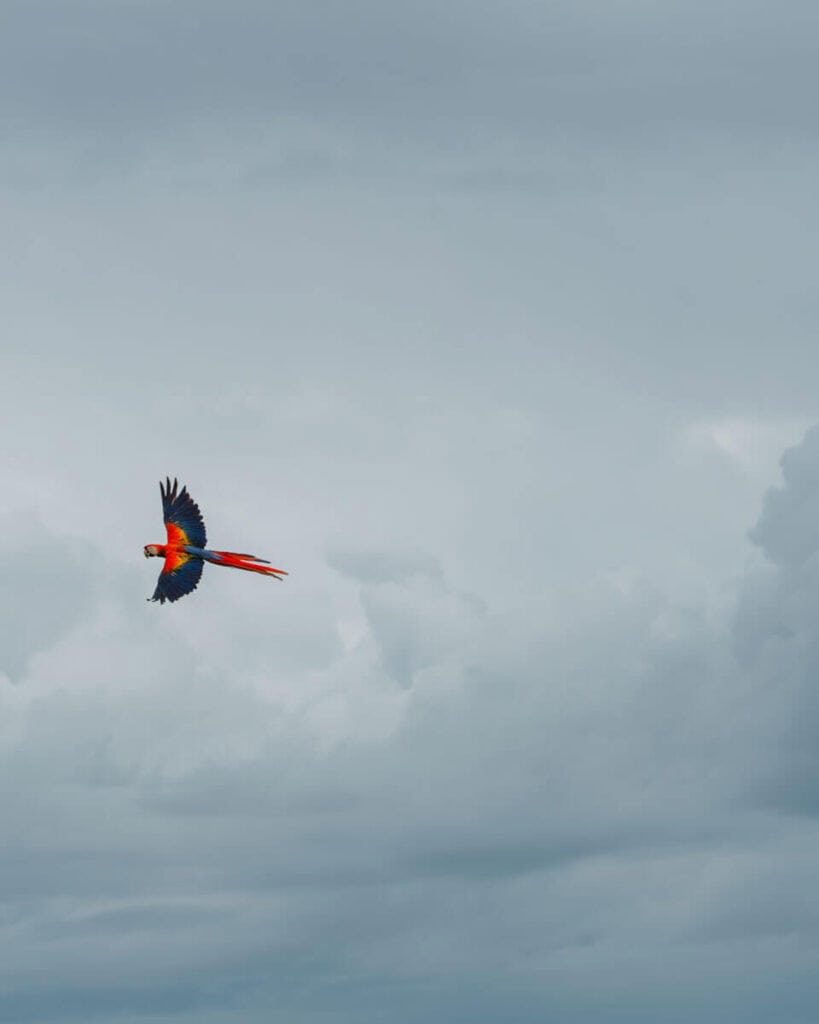
- 🦜 Scarlet macaws (the last significant population of these birds anywhere in Panama)
- 🦗 All kinds of insects (53 new species have been discovered on the island!)
- 🐍 Snakes (boa constrictors, fer-de-lance, coral)
- 🐸 Frogs and toads
- 🦎 Iguanas and lizards


Where is Coiba Island
To put it into perspective, Coiba Island is almost 50 km (31 mi) from the surf town of Santa Catalina, the most common departure point on the mainland. The boat trip takes at least 1 hour and 15 minutes.

How to visit Coiba Island
Being a protected national park and such a remote island, Coiba Island can only be visited as part of a boat tour with an authorised operator.
Most tours depart from Santa Catalina, as it is the closest tourist destination to the island, but local boats do leave from neighbouring local towns.
There are a couple of different ways you can experience Coiba:
- 🤿 Day tour with snorkelling
- 🦈 Scuba diving
- ⛺️ Overnight or multi-day tour
No matter how you choose to visit Isla Coiba, you will need to pay the national park fee. It is $5 for Panamanians and $20 for foreign visitors, per day. Most tour operators do not include this in the cost of their tour, and they usually like you to pay this fee in cash.

Day tour with snorkelling
- ⏰ Duration: 7 – 8 hours
- 💰 Approx. cost: $65 – $90
- 🤿 Recommended operators: Expedicion Coiba or Discover Coiba
- 🗓️ When: year-round
This is the most common and affordable way to visit Coiba Island, particularly if you’re not a certified scuba diver.
Tours depart daily from Santa Catalina and generally include 2 to 3 stops for snorkelling, a short stop on Coiba Island to hike to the lookout and lunch and beach time on one of the smaller islands. I believe the island closes to visitors sporadically for conservation reasons, if you don’t visit Coiba itself, you’ll visit one of the other 38 islands.
Most tours don’t visit the site of the former penal colony as it is in a different part of the island. And now possibly home to actual prisoners again anyway?
If you’re short on time (or money) this is a great way to get a feel for the national park and the islands, but it’s by no means an in-depth exploration.
This is how we decided to visit Isla Coiba, and I’ve got a more detailed description of our day below.
Scuba diving
- ⏰ Duration: 7 – 8 hours
- 💰 Approx. cost: $160 (2 dives) | $180 (3 dives)
- 🤿 Recommended operators: Expedicion Coiba, Panama Dive Center or Diving Coiba
- 🗓️ When: year-round
If you are a diver (or want to learn) scuba diving around Coiba is some of the best in Central America.
Multiple dive shops in town offer daily dives year-round. There are dozens of dive sites around the islands, and your dive shop will choose the best ones based on the weather and conditions.
Most companies will let you choose if you want to do two or three dives, with the third dive being dependent on the weather.
Obviously, diving will get you deeper underwater, and generally a better chance of seeing more marine life. However, it sacrifices time on land.
You will stop on one of the islands for a brief lunch break and surface interval, but divers generally don’t have the opportunity to hike on Coiba or explore any of the islands too much.
We spent ages trying to decide if we wanted to dive or snorkel, and in the end, we decided to skip diving.
Partly for the cost, as we were at the end of our 6-month trip and it was going to be more than double the price. Also because I really wanted to see the island and at least do a short hike through the forest. The weather was also a factor in our decision, as it was wet season so it was overcast and the water visibility wasn’t great.
Overnight tours
- ⏰ Duration: 2 – 4 days
- 💰 Approx. cost: $290 (1 night) | $460 (2 nights) | $675 (3 nights)
- 🤿 Recommended operators: Discover Coiba
- 🗓️ When: November – April only
If I had my time again, THIS is how I would have loved to see Coiba! Unfortunately, we were too late and tours had finished for the season.
Discover Coiba offers multi-day trips where you camp on one of the islands. It’s a rustic and adventurous experience, fully immersed in the raw nature of the national park.
With more than one day, you have time to explore the area above and below the surface, with snorkelling and longer hiking opportunities.
You were able to visit the historic penal colony and get a better feel for what this wild island might have been like when it housed thousands of dangerous criminals. Now that the island may possibly house prisoners again, I don’t know what this looks like for tours. You obviously won’t be going anywhere near high-risk prisoners, but I’m not sure if they are using the old prison or putting them somewhere different on the island.
Best time to visit Coiba Island
The best time to visit Coiba Island is during Panama’s dry season from November to April.
This is the best chance of having a clear, sunny day with no rain, so you can see the sparkly blue waters. It also means you have the opportunity to join an overnight tour if you wish.
This also coincides with whale shark season, which is usually from January to April. There is no guarantee of seeing these huge creatures, but visiting in this period will give you the best chance.

What to bring to Coiba Island
This list will differ slightly depending on the tour option you choose, but you will at least need to pack:
- 👙 Swimwear
- 🧖🏽♀️ Towel
- ☀️ Rash vest or wetsuit (for sun protection and warmth in the water)
- 😎 Sunglasses
- 🧥 Shirt or raincoat (to stay warm on the ride back)
- 👟 Shoes (you’re comfortable in for a short jungle walk)
- 💧 Reusable water bottle (most tours will have somewhere to refill)
- 🧁 Snacks (if you’re a hungry person, you might want a snack before lunch!)
- 💊 Sea sickness tablets (if needed)
- 📷 GoPro or waterproof phone case (we’ve recently upgraded to the DJI Osmo Action 6 for our underwater content and it is SO much better than the GoPro)
- 💰 Cash (for your NP fee)
- 🛂 Passport (confirm with your tour company, the rangers sometimes require you to have your passport on the island to check your status)
- 🎒 Waterproof bag (to keep your things dry on the boat, but most will have dry storage)
🎒 Find out exactly what’s in our backpacks! I’ve listed all our travel gear on my Amazon shopfront

Our day tour experience
After much deliberation about diving vs snorkelling and some sooking on my behalf that I didn’t know about the April finish date for the overnight tours, we finally decided on a day tour to Coiba, with snorkelling.
We booked our tour with Expedicion Coiba and were very impressed with them from start to finish! We paid $65 each, which we were able to pay by card (not so easy in Santa Catalina), plus our $20 national park fee.
Sustainability at Coiba Island 🌿
We can’t speak for every tour operator, but our experience with Expedicion Coiba and the incidental contact we had with the dive boats and other tours was that everyone in Santa Catalina cares very deeply for Coiba.
We had a thorough briefing about the reef, the marine life and safe snorkelling practices, with an emphasis on not touching or damaging anything. This was actually enforced too, and it was not the kind of tour where the guides are just trying to get photos of you with a turtle so you leave a good review.
Our tour had no single-use plastic, all our lunch was served with reusables and they had big gallons of water to fill our bottles with. We picked up any rubbish we saw in the ocean, and our guide was knowledgeable about the flora and fauna on the islands.
I was super impressed and it really felt like the locals want to keep Coiba remote, untouched and pristine. It was very sustainably managed, and maybe it is a bit different in peak season, but it didn’t feel overcrowded at all.
Getting to Coiba Island
The day of our tour rolled around and unfortunately, it was looking very grey and overcast. Although I was positive the clouds would shift and we would get to see the sparkling emerald waters in the sunshine.
We met at the Expedicion Coiba office at 7:45 am for a briefing and to get our gear ready for the day. We have our own snorkels, but they gave Brayden longer freediving fins and everything was good quality.
Our group was made up of 8 people from all over the world, which was a nice, small number.
After everyone was organised, we walked down to the beach, jumped in the boat and started the long journey out to Coiba. It was a small panga boat but our group was small enough that we were comfortable and not squished in.
The journey was going to take at least 1 hour and 15 minutes, but within 10 minutes of leaving Santa Catalina, we found a huge pod of dolphins! We spent a while watching them swim and hunt, and there were dozens of them swimming alongside the boat.
The rest of the ride was uneventful, it was pretty smooth and the time went quickly. I was on the lookout for humpback whales, just in case any had arrived in the area early!
They usually migrate past Coiba between July – September, but I figured it was worth looking in mid-June. Especially because I knew we weren’t going to be able to see any whale sharks (they were long gone, moving on from the area in April).
As we neared the islands, I noticed the water colour changing. From the deep, dark ocean, it lightened to a sparkling emerald colour, perfectly contrasted against the little islands dotted with palm trees.

First snorkel spot
We pulled up to our first snorkel spot, which our guide chose based on the high tide and wind conditions.
Within seconds of putting my head under the water, I spotted thousands of bright fish swimming in huge schools, and a sea turtle.
Brayden and I threw each other the okay symbol (👌🏼), a shaka (🤙🏼) and some awkward snorkel smiles. After some disappointing diving and snorkelling the previous months (including in Bocas del Toro), we were both so excited to finally be surrounded by marine creatures of all shapes and sizes.
We spent an hour at the first site and I don’t think anyone wanted to get out! We were snorkelling along a sea wall that was absolutely full of life. It was a rocky, hard coral reef, not the soft and vibrant colours you’d see on the Caribbean Coast but that didn’t matter – there were animals everywhere!
There were times when I literally didn’t know where to look, a huge turtle would be swimming past me in one direction, a stingray shimmying along the sandy floor below me and a white-tip reef shark in the other direction. It was incredible.

Coiba Island
Our guide finally dragged us out of the water, and we jumped back in the boat to our next stop – Coiba Island itself!
The island is enormous and covered in a thick layer of dense, green forest. We pulled up on the beach near the ranger station, where a few rangers and military guys were hanging around a few small buildings.
Our guide gave us the option to hang around on the beach or go on a hike up to a lookout. Obviously, we went for the hike, and a few of us trudged through the muddy and slippery jungle.
I knew this was only a tiny percentage of all the wild nature to be found on Coiba Island, but I was so happy we had the opportunity to see even a small part of it.
Our guide pointed out different birds and lots of insects including the biggest grasshopper I’ve ever seen!
We could hear the call of howler monkeys in the distance and eventually saw one hiding high up in the trees. We’d seen howler monkeys before, and this one didn’t necessarily look that different, but I was so amazed to see a species of animal found ONLY on Coiba!
We made it to the mirador, where we got some amazing views back towards the ranger station and of all the small islands dotted around Coiba.
We eventually walked back down, had a chat with the rangers, picked up the rest of our group and headed off to our next stop!

Lunch on Isla Rancheria
We pulled up on a pristine, white sand beach on Isla Rancheria. The water was so calm and clear, and the shoreline was covered in a grove of palm trees!
I gather this is the most popular spot for lunch, and there were a couple of other boats here, including scuba divers. It wasn’t too busy though and there was a nice, friendly vibe, not a cramped, hectic energy that some boat tours can have.
While our guides set up lunch, we had a wander along the beach and checked out the small section of the island that was accessible. We could see dense forest rising up behind the beach, and again, were astounded how wild and undiscovered these islands are.
We had a delicious spread of all kinds of sandwiches, fresh fruit, cookies and juices for lunch. We were all starving after a big snorkel and everything was so tasty! One of the guides even climbed (yes, climbed!) one of the palm trees to shake out some coconuts for us.
Rancheria is famous for the crocodile that lives in the swampy estuary that runs through the island. We were lucky enough to spot him lurking on the surface.


Second & third snorkel spot
After a swim in the dreamy, turquoise waters it was time to move on to our second snorkel spot, near Isla Canales.
The second location was a deeper, more open area. Similar to the first, there was marine life everywhere! More turtles, more sharks and more huge schools of fish.
We didn’t drive too far to our third and final snorkel spot. There were some big rocky outcrops that we swam around.
Instead of rushing around madly looking for any marine life I could find, I decided to take it slow and simply look at what was in front of me. I floated in one place for quite some time, letting the schools of fish engulf me. Without even trying I saw another huge sea turtle.
Brayden and I both loved that we weren’t forced to wear a life jacket if we didn’t need one, and we didn’t have to swim right alongside our guide. He jumped in with us and pointed out anything he found if you wanted to stick with him, but we were allowed to explore independently around the area.

Back to the mainland
Everyone was exhausted by the time we got back in the boat, and we had a long journey ahead of us.
It was a bit choppier on the return journey, and I was absolutely freezing being wet in the wind. I wish I’d packed a raincoat to keep warm!
The boat ride felt quick and a lot of the group had their eyes closed after an exciting but exhausting day. We got back to Santa Catalina just before 4:00 pm, tired but so happy and grateful to have been able to explore such a special part of Panama.
The clouds hadn’t budged all day, and I was a bit disappointed we didn’t get to see the island and beautiful waters in the sunshine, but c’est la vie, it was still an incredible day!
We couldn’t fault Expedicion Coiba. Our captain and guide were friendly, knowledgeable and organised with great communication. They ran a smooth, safe and fun day and it was clear to me they loved their work and the islands.

Final thoughts: Coiba Island Panama
Coiba Island was incredible! Even though we had bad weather, and it was grey and cloudy the ENTIRE day, it was still amazing.
The amount of marine life we saw just from snorkelling was mind-blowing, and the only other place we have been able to see sharks, turtles and rays in one go was snorkelling in Caye Caulker, Belize.
I am so fascinated by the history of the island and truly amazed at what nature has been able to do when it’s left alone and not destroyed by humans.
Coiba is a special place and a must-visit in Panama. Yes, it’s a long boat ride, and yes, Santa Catalina isn’t the easiest place to get to, but it’s 100% worth it.
Check out my Santa Catalina guide to help plan your trip to this tiny little surf town, so you can get out to Coiba Island!
MORE SANTA CATALINA POSTS

The Comments
Lorena
Sally, I’m very afraid of diving (even snorkeling) but I don’t want to miss this opportunity. Do you think it’s worth it even if I’m afraid of diving? Will I be able to see the animals (like the whale shark) from the boat?
Sally Rodrick
LorenaHi Lorena, there is never any guarantee of seeing whale sharks under the water, let alone from above but I don’t think you would see much marine life unfortunately if you don’t want to dive or snorkel. I’d still recommend visiting Coiba on a snorkelling tour, just make sure you choose one that spends some time on the islands too – it’s worth seeing 🙂 We did a hike on one island and had lunch and beach time on another, so still plenty of activities for non-snorkelers.